

A Malibu home owned by Hollywood producer David Hoberman has returned to the luxury market, asking $12.9 million for a private contemporary estate overlooking the Pacific.
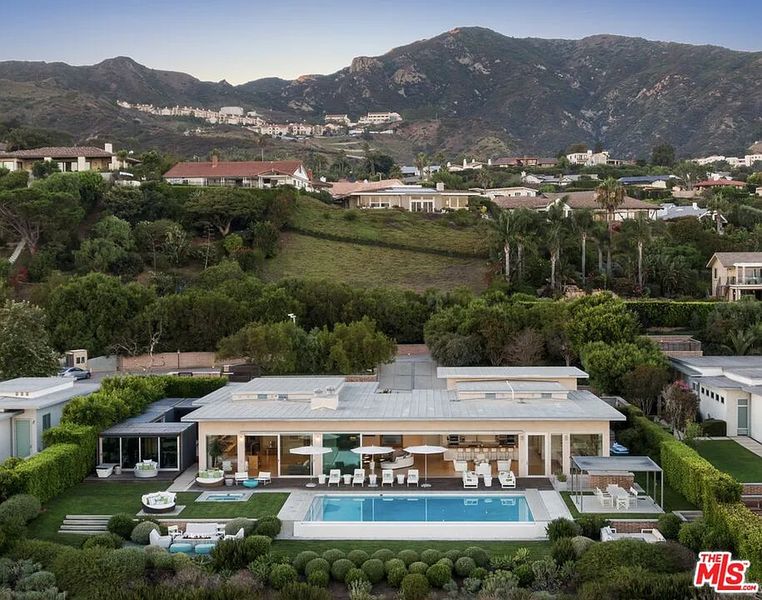
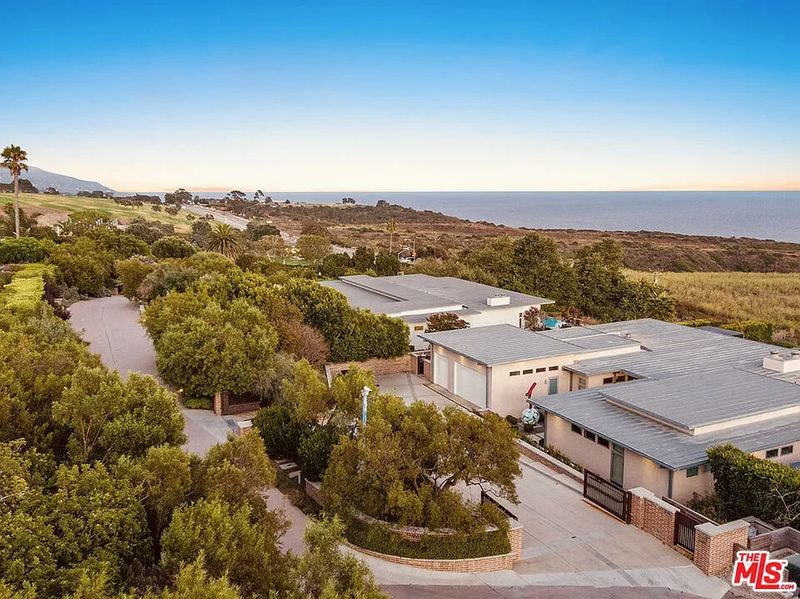
Located at 24685 Pacific Coast Highway within the gated blufftop enclave known as The Who, the approximately 8,110-square-foot residence combines expansive ocean views with the kind of indoor-outdoor architecture that has become synonymous with Malibu’s most coveted modern homes. The property sits on roughly 1.06 acres and includes four bedrooms and six bathrooms, along with an infinity-edge pool, detached guest suite and art studio, exercise pavilion, media room, outdoor kitchen and dining cabana.
The current listing is represented by Sandro Dazzan of The Agency, with Stephen Sigoloff of Carolwood Estates also on the listing, according to current MLS-derived records. The home was listed at $12.9 million in July 2026 under MLS No. 26862665.
For californialuxuryhouses, the property is particularly notable because its story extends beyond the celebrity name attached to it. Hoberman did not simply purchase a finished Malibu trophy home. He acquired the contemporary residence while it was still unfinished and subsequently shaped it around his interest in art, architecture and the Pacific landscape.
David Hoberman’s Malibu Home Was Purchased While Still Unfinished
Hoberman purchased the property in 2016 for $7.5 million, according to contemporary reporting. At the time, the residence was described as an unfinished contemporary villa in The Who, a small gated community perched above Pacific Coast Highway. The home had been designed by Malibu architect and designer Scott Gillen, whose Unvarnished approach emphasized low-slung forms, glass, natural materials and a strong connection to the surrounding landscape.
The property’s construction history requires a small clarification. Current property databases generally identify the residence as having been built in 2015 or 2016, while the 2016 report describing Hoberman’s purchase said the house was not yet complete and had been projected for completion in fall 2015. Current MLS-derived records list 2016 as the year built. For accuracy, California Luxury Houses considers 2016 the more useful reference point for the completed residence while noting the discrepancy in publicly available records.
The acquisition also fits into a longer Malibu and Los Angeles real estate history for Hoberman. In 2014, he sold a substantially larger Brentwood estate for $17.85 million. That property, which he had purchased in 1990 for $4.9 million, included nearly two acres, a 9,200-square-foot house, a pool and a separate pool house/theater.
Hoberman’s professional background helps explain the unusual intersection of entertainment, art and architecture found at the Malibu residence. He is the founder and co-owner of Mandeville Films and Television and was the producer behind the television series Monk. His credits also include The Proposal, The Fighter and Disney’s live-action Beauty and the Beast. Mandeville says the company was founded by Hoberman in 1995 and has produced films across a wide range of genres.
That background is relevant to the house because the residence was developed not simply as a large coastal property, but as a setting for art and entertaining.
Inside the Contemporary Malibu Estate
The approach to the house establishes the architectural language before the front door even comes into view. Oversized concrete slabs are separated by dark gravel, while rounded landscaping softens the property’s sharp contemporary geometry.
The home itself is arranged largely across a single level, an increasingly desirable feature in the luxury market for buyers who want substantial square footage without the vertical circulation of a multistory mansion.
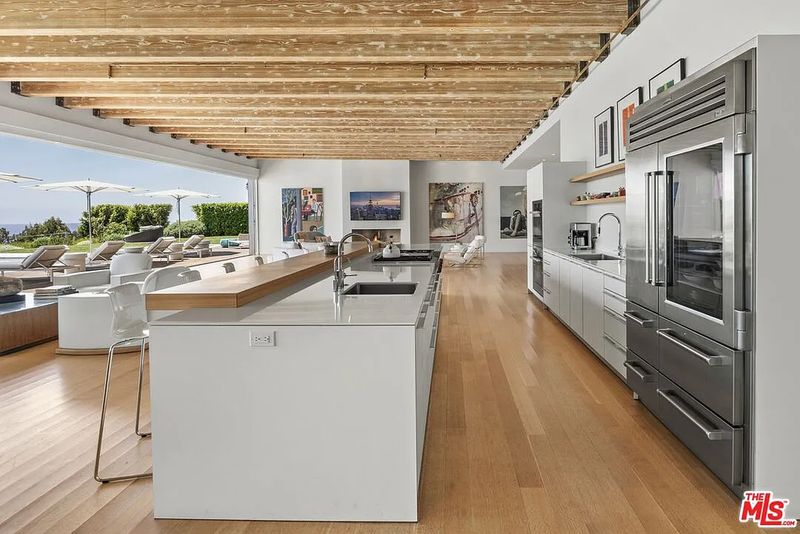
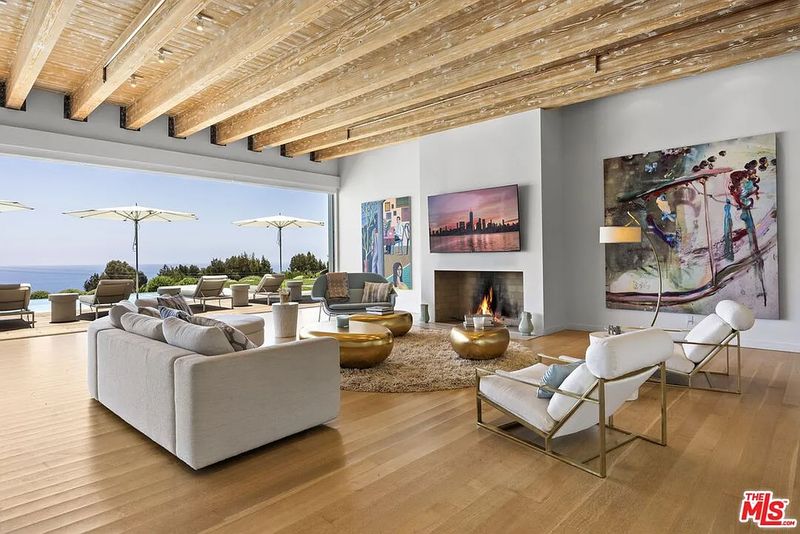
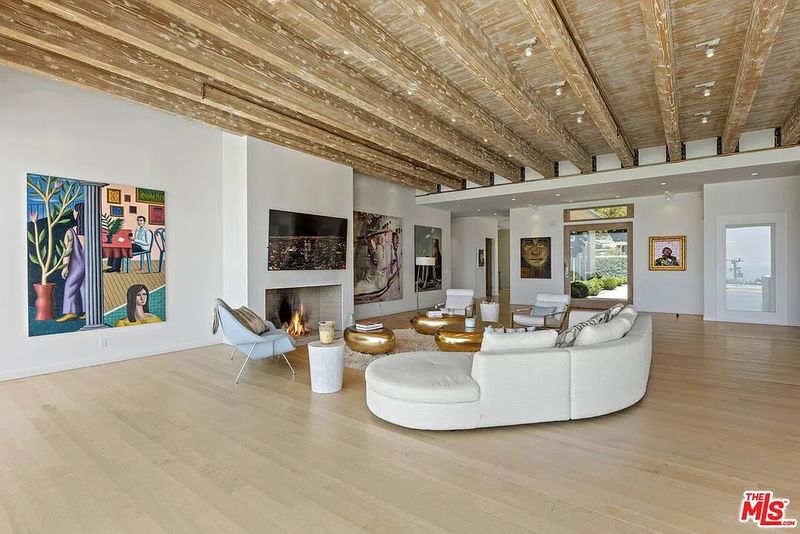
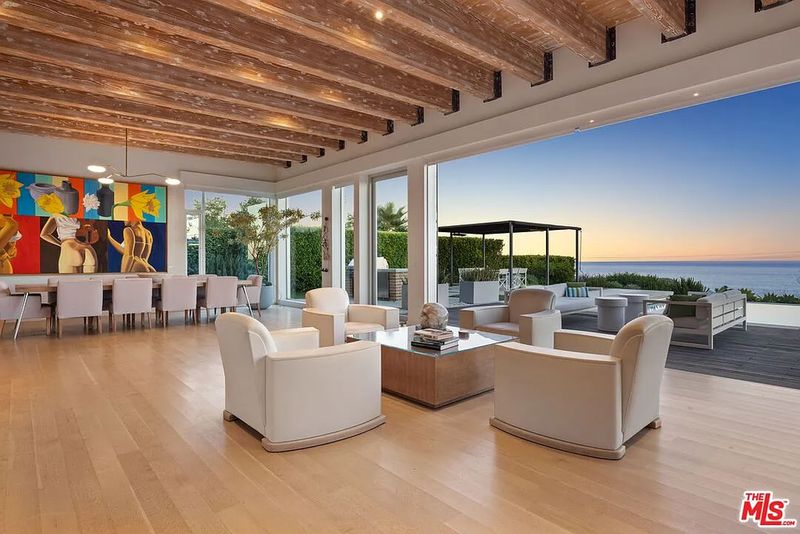
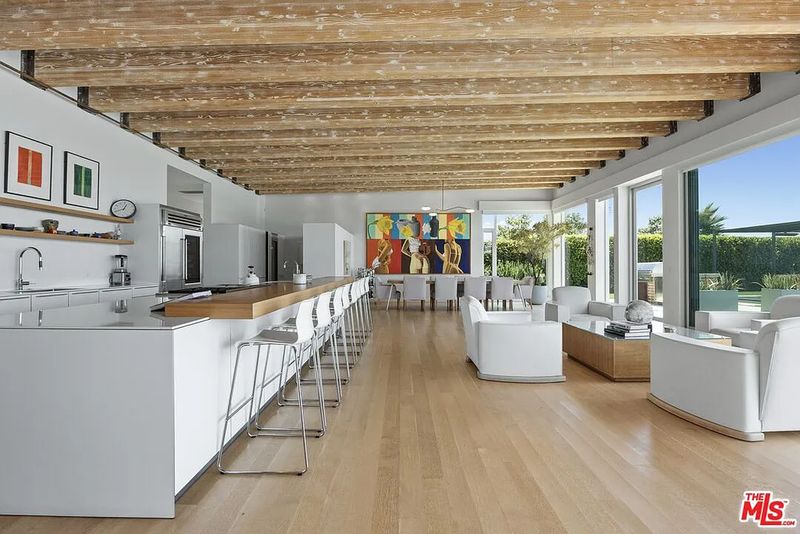
At the center is a great room with 13-foot exposed wood-beam ceilings and wide-plank white oak flooring. Floor-to-ceiling Fleetwood glass doors face the Pacific, allowing the main living spaces to open directly toward the terrace, pool and ocean beyond.
The kitchen is fitted with Bulthaup cabinetry and high-end appliances, while the open plan brings the kitchen, dining area and multiple seating zones into one continuous entertaining space. Rather than separating formal rooms from everyday living, the architecture allows the entire ocean-facing side of the residence to function almost as one large coastal pavilion.
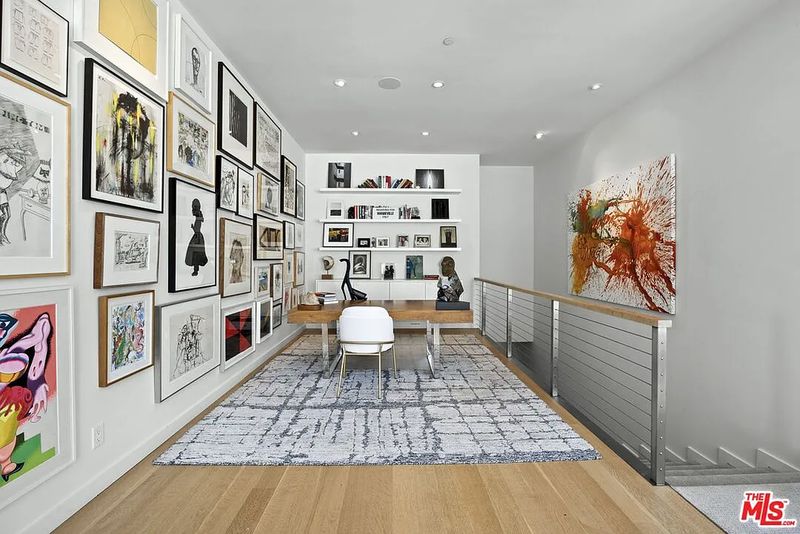
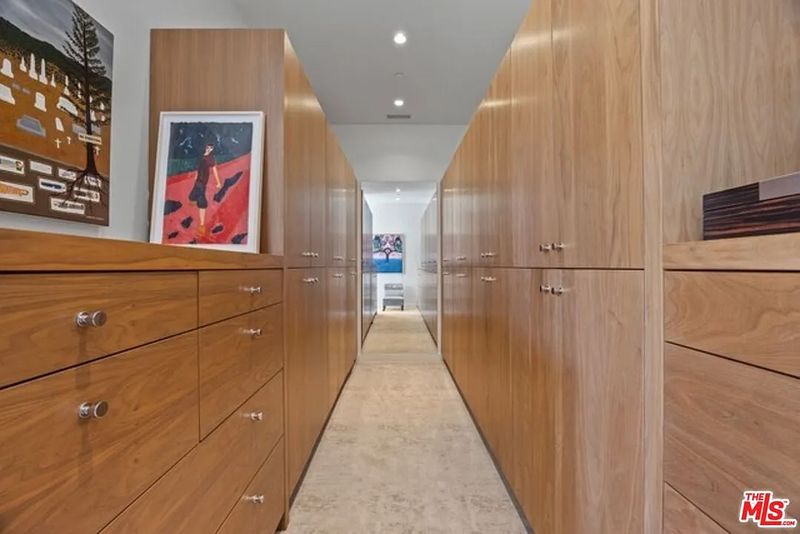
The listing materials emphasize the property’s appeal to art collectors, pointing to its gallery-like walls, generous living areas and the detached art studio/guest accommodation. That emphasis makes sense within the context of Hoberman’s ownership: the home was customized after his acquisition rather than being treated as a finished spec residence.
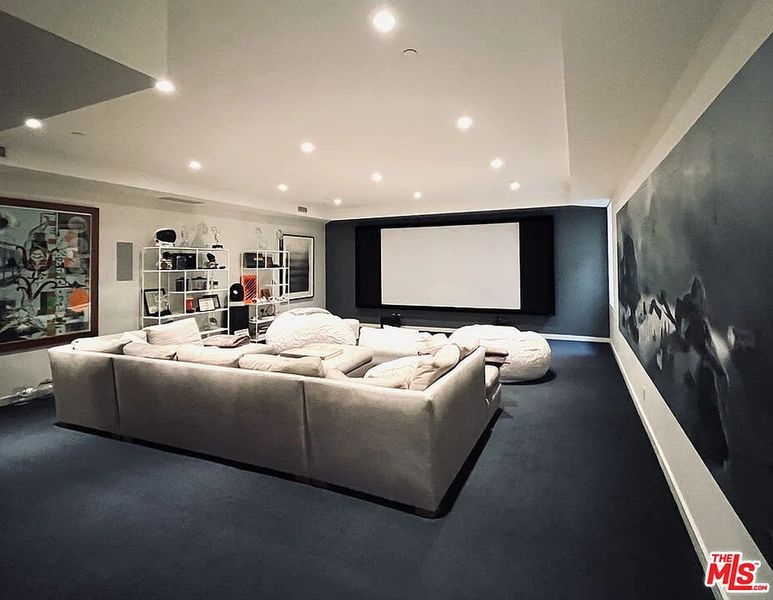
A separate media room occupies the lower level, providing a more enclosed counterpoint to the home’s otherwise open and glass-heavy design.
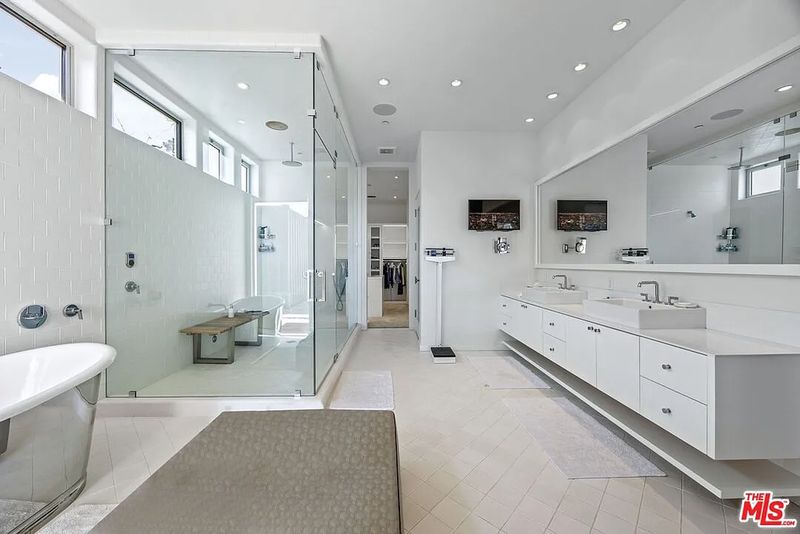
The primary suite returns the focus to the ocean. The bedroom faces the Pacific and includes exposed wood beams, a fireplace and direct access to the outdoor areas. Its bathroom has dual floating vanities, a glass-enclosed shower and freestanding soaking tub, while the adjoining dressing room is lined with full-height cabinetry.
Outside, the property becomes more resort-like.
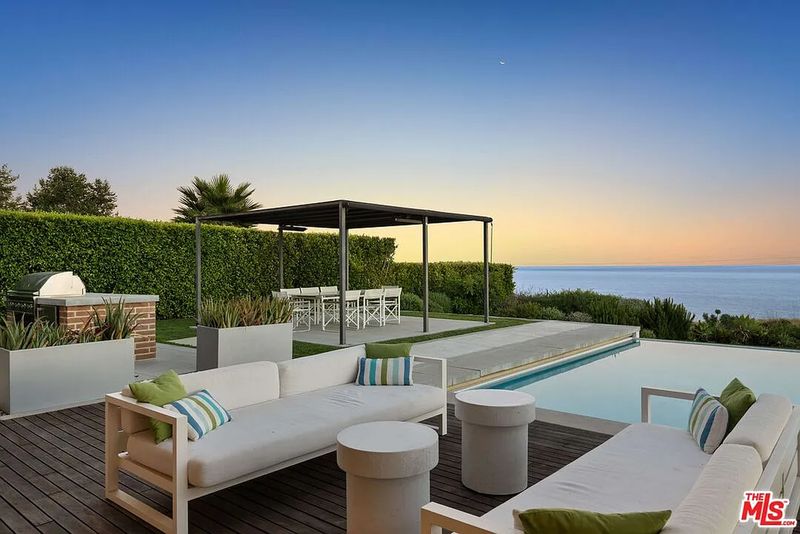
The long infinity-edge pool runs parallel to the residence, with lounge areas positioned to capture the ocean horizon. A separate spa, fire-pit lounge and landscaped garden extend the entertaining area beyond the main structure.
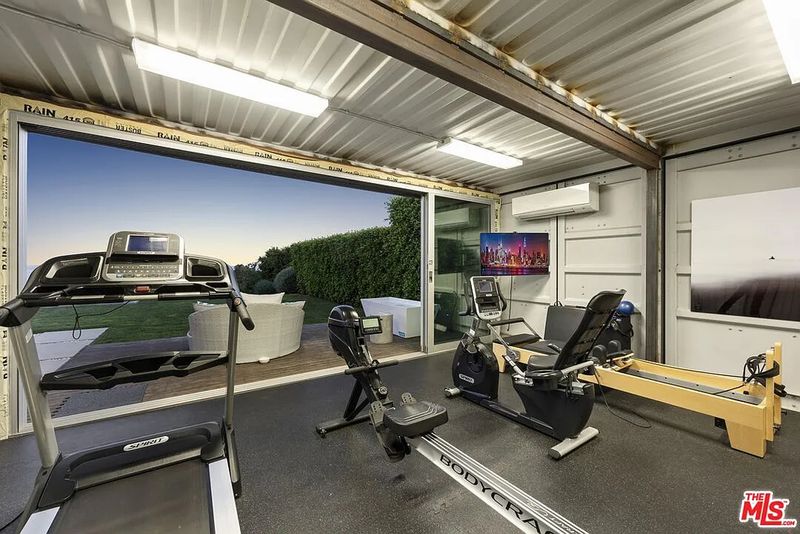
An exercise pavilion adds another layer to the compound. The glass-walled structure is equipped for workouts and wellness activities, while the outdoor kitchen and covered dining cabana create a second destination for entertaining away from the main house. Current listing materials specifically position the pavilion as a potential gym, meditation or yoga space.
In that sense, the property is less a conventional four-bedroom Malibu house than a compact private retreat organized around art, wellness, entertaining and the ocean.
A Malibu Location Built Around the Coastal Lifestyle
Location is one of the property’s strongest assets.
The home sits along Pacific Coast Highway within The Who, a four-estate gated blufftop enclave. Its position gives the residence an unusual combination of privacy and proximity to Malibu’s commercial and social center.
The Malibu Country Mart is nearby, providing access to upscale boutiques, restaurants, wellness businesses and everyday services. The center describes itself as a seaside destination for shopping, dining and relaxation, with its six-acre property located in the Malibu Civic Center. Its current directory includes restaurants, fashion retailers, galleries, wellness providers and personal services.
The Park at Cross Creek provides another convenient retail and grocery destination, anchored by Whole Foods and complemented by restaurants and specialty retailers.
For dining, the broader Malibu Civic Center area puts residents within easy reach of some of the city’s best-known restaurants, including Nobu Malibu, while the Country Mart offers a range of more casual and upscale options. The lifestyle is distinctly coastal: morning coffee, shopping, lunch overlooking the Pacific and an evening drive along PCH can all become part of the daily rhythm.
The beaches are equally central to the property’s appeal. Malibu has approximately 21 miles of coastline, with public beaches and coastal access points stretching along Pacific Coast Highway. Malibu Surfrider Beach, Malibu Lagoon State Beach, Point Dume and Zuma Beach are among the better-known destinations.
That access also reinforces what makes this particular residence different from an inland Los Angeles mansion. The value proposition is not simply the house itself. It is the combination of privacy, architecture and a direct relationship with Malibu’s coastline.
From a $7.5 Million Acquisition to a $12.9 Million Listing
The property’s transaction history adds another interesting layer to its return to the market.
Hoberman bought the unfinished residence for $7.5 million in 2016. Publicly available property data subsequently records the home as being offered for rent in 2025, with a lease reported at $47,500 per month in October of that year. The residence was also marketed for sale at $15.495 million in January 2025 before that listing was removed later in the year.
By July 2026, the asking price had been repositioned to $12.9 million, according to current MLS-derived listings. At that price, the residence is being offered at roughly $1,590 per square foot based on its 8,110 square feet of reported living area.
The reduction from the earlier $15.495 million asking price is significant. It also illustrates a broader reality of the upper end of Malibu real estate: even architecturally distinctive properties with celebrity provenance must ultimately find a price that aligns with current buyer expectations.
The residence’s 2025 rental history suggests that it has also functioned as an income-producing luxury asset rather than solely as a private owner-occupied retreat. That flexibility may appeal to a buyer who wants a Malibu base that can alternate between personal use and high-end rental occupancy, subject of course to applicable local rules and restrictions.
For now, the identity of any prospective buyer remains unknown. The current listing materials do not disclose a reason for Hoberman’s decision to sell, and there is no verified public statement from Hoberman explaining the timing of the move.
California Luxury Houses also found no independently published interview in which the current listing agents provided direct quotations about Hoberman’s ownership or the reasons behind the sale. Rather than manufacture comments that cannot be independently verified, this report relies on the listing materials, public property records and previously published reporting. That distinction matters when documenting a celebrity-owned property where ownership history can easily become mixed with marketing language.
What is clear is that Hoberman’s Malibu home has evolved considerably from the unfinished contemporary residence he purchased a decade ago. Its current identity reflects the original architectural vision of Scott Gillen and the customization undertaken during Hoberman’s ownership, particularly the home’s relationship with art, natural light and the Pacific.
Now offered at $12.9 million, the estate is positioned for a buyer who values Malibu not as a backdrop, but as the central element of the home itself. The architecture keeps the ocean in view, the single-level plan favors relaxed movement, and the outdoor spaces turn the property into something closer to a private coastal resort.
For an art collector, entertainment executive or buyer searching for a highly private Malibu compound without the scale and maintenance burden of a sprawling mega-estate, Hoberman’s residence offers a more restrained interpretation of California luxury—one in which the Pacific, rather than the architecture alone, remains the star.