
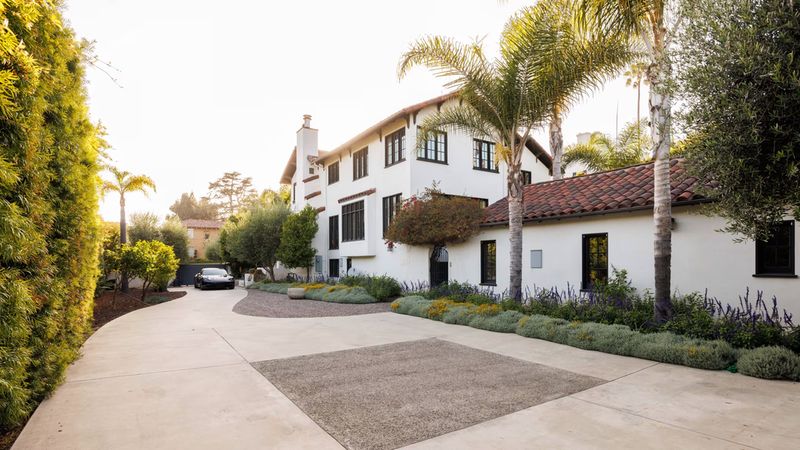
A 1923 Spanish-style residence in Los Angeles’s coveted Los Feliz neighborhood, once owned by actor Michael C. Hall and later transformed by designer and De Maroc founder Emmy Ellison, has returned to the market for $6.5 million.
Set behind gates and mature landscaping on Nottingham Avenue, the 5,618-square-foot home offers something increasingly unusual in contemporary Los Angeles real estate: historic architecture with a distinctly personal interior.
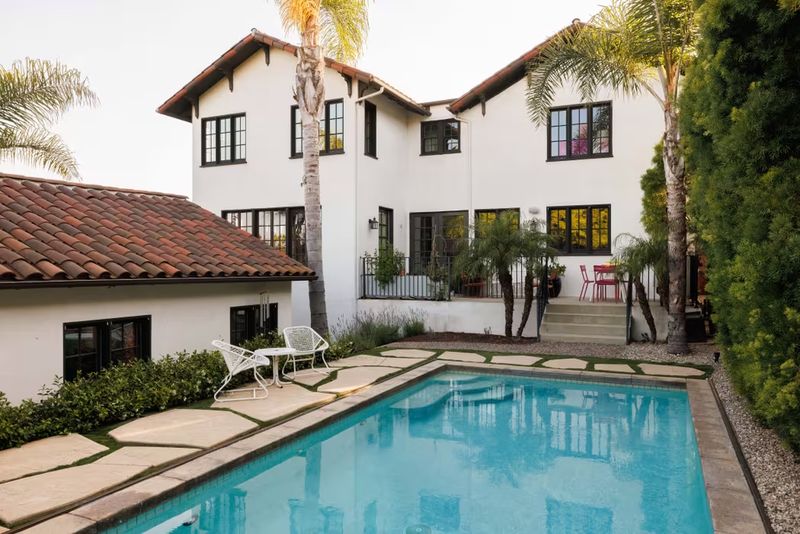
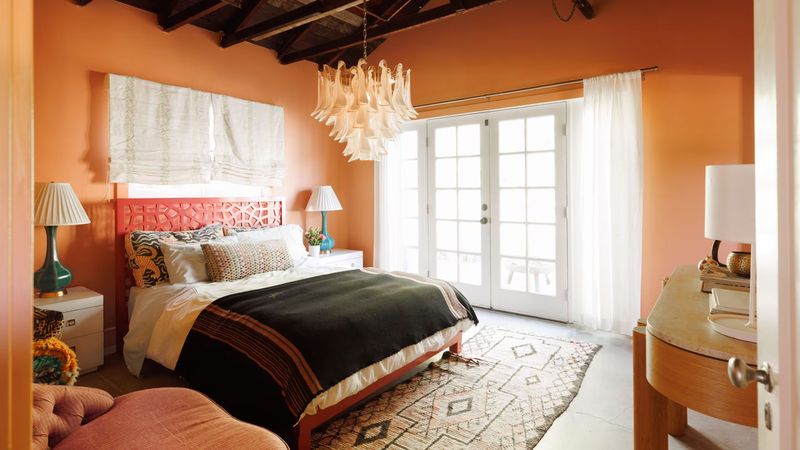
Rather than stripping away the character of the nearly century-old residence, Ellison filled it with saturated color, vintage furnishings, Moroccan rugs and collected pieces, creating a home that feels more like a private design world than a conventional luxury listing.
The property’s celebrity history adds another layer. Hall, best known for his roles in “Dexter” and “Six Feet Under,” purchased the Los Feliz house for approximately $3.825 million in 2013. Ellison acquired it in 2016, according to her account, after Hall had leased the residence to actor Armie Hammer and his then-wife, Elizabeth Chambers.
Today, the Michael C. Hall Los Feliz home is asking $6.5 million, positioning it among the more distinctive historic residences currently available in the neighborhood.
A 1920s Spanish Home Reimagined Through Color
The house dates to 1923, according to public property records, and occupies a roughly 0.35-acre double lot. The current listing describes five bedrooms and six bathrooms across approximately 5,618 square feet, with a detached guest house, swimming pool, landscaped gardens and a three-car garage.
Its architecture belongs to the Spanish-style tradition that helped define Los Angeles residential design during the 1920s. But inside, the atmosphere is considerably more expressive.
Ellison, who founded the vintage Moroccan rug company De Maroc, brought an appreciation for texture, craftsmanship and color into the residence. Architectural Digest previously profiled the home, describing how its interiors combined Southern influences, Moroccan textiles and contemporary design under Ellison’s direction.
The transformation is particularly apparent in the public rooms.
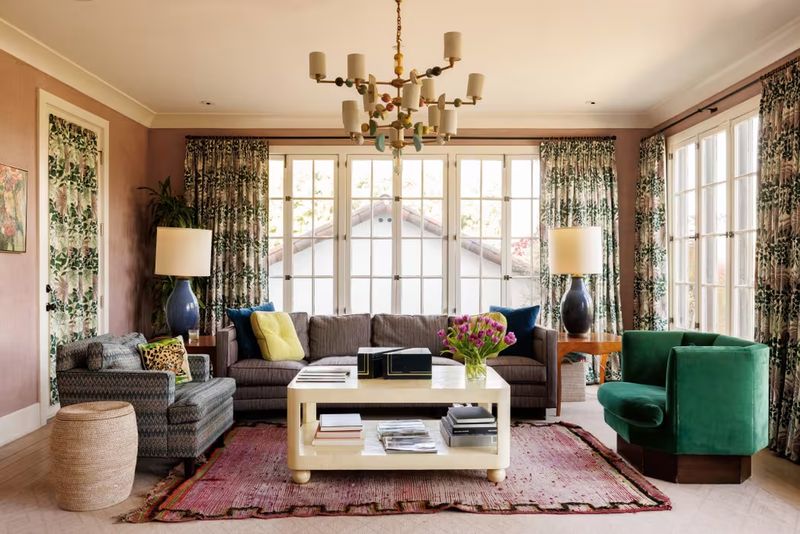
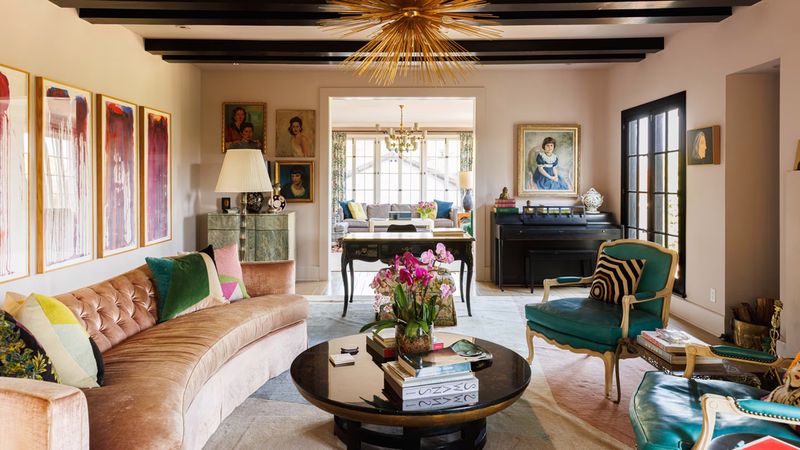
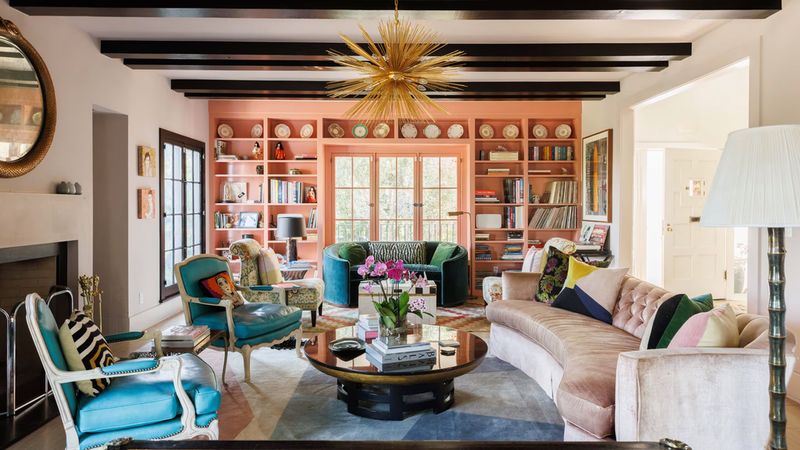
The formal living room retains a classic arrangement centered around a wood-burning fireplace, built-in bookshelves and a sculptural starburst chandelier. Rather than relying on a neutral palette, however, the rooms incorporate rich tones and vintage furnishings that give the historic architecture a more intimate, collected character.
Listing agent Sonya Coke of Sotheby’s International Realty’s Los Feliz Brokerage sees that personality as one of the property’s greatest advantages.
“I like that the house is filled with personality,” Coke said. “It’s not your usual cookie-cutter, where everything is white and boring.”
That distinction matters in a luxury market where many renovated houses are presented with similarly restrained palettes and highly polished finishes.
Here, the design is intentionally individual.
A Dining Room Designed Around a California Landscape
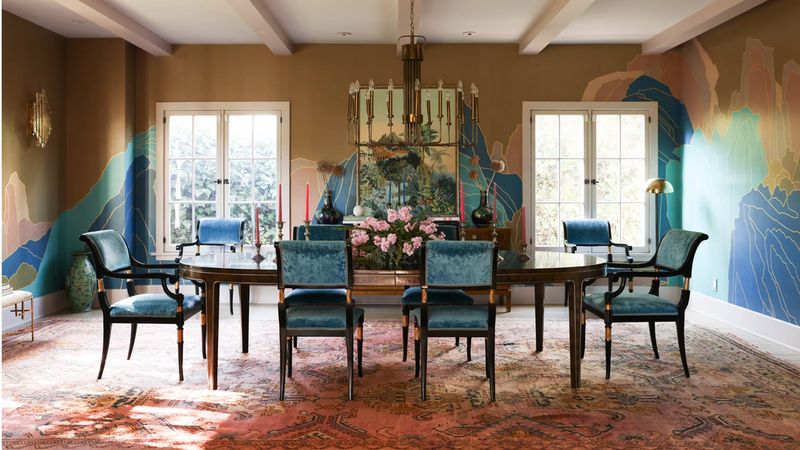
Perhaps the most memorable room is the formal dining room, where a hand-painted abstract mural by Fromental depicts the mountains of California.
The artwork is more than a decorative accent. It provides the visual foundation for the room’s broader palette, with furniture and fabrics selected to complement the mural.
Ellison has previously explained that her approach to color was influenced by her mother, who worked as an interior decorator. Rather than treating color as a finishing touch, she viewed it as a way of connecting the individual elements of a room.
“I am a pretty monochromatic black dresser, but there is something about color—I have not been afraid of color,” Ellison said.
She added that growing up around her mother’s work taught her how colors could be pulled together through artwork.
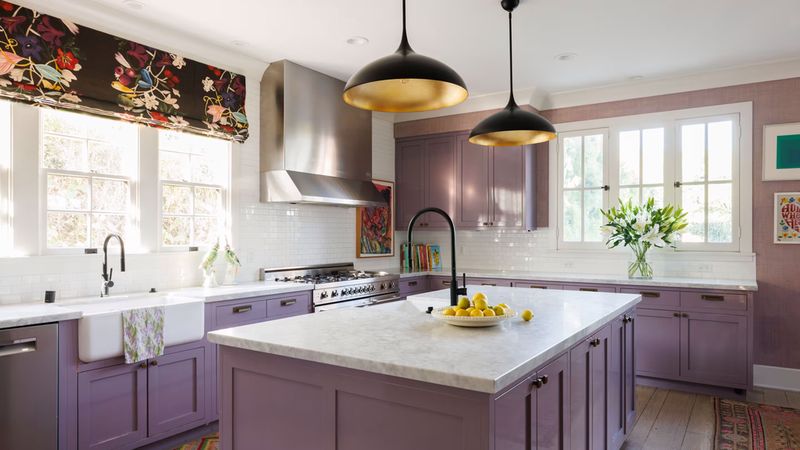
That philosophy is visible throughout the residence, where dusty lilac, deep blue, green and jewel tones appear alongside natural wood, vintage rugs and more traditional architectural elements.
The dining room also reflects the home’s balance between formal entertaining and everyday living.
“I love having a formal dining room,” Ellison said. “I also love to have a fun, casual eating area in the kitchen. This house has it all.”
From Celebrity Residence to Design Studio
The history of the Michael C. Hall Los Feliz home adds another intriguing chapter.
Hall acquired the property in 2013 for $3.825 million, according to public records and contemporary reports. At the time, the house was marketed as a restored Spanish Colonial residence with more than 5,600 square feet, multiple bedrooms, a guesthouse, pool and views toward the hills and city.
The transaction was itself part of a rapid period of appreciation. Public sales records show the property had changed hands for $2.09 million in May 2012, before selling to Hall for approximately $3.825 million the following year.
Ellison purchased the property from Hall in 2016 for $4.85 million, according to recorded sales data.
California Luxury Houses reviewed the property’s publicly available sales history, which shows that its recorded sale price has risen from $2.09 million in 2012 to $4.85 million in 2016, before its current $6.5 million offering. The property’s latest asking price represents a notable repositioning from the $7.995 million price at which it was listed in July 2022.
For buyers interested in luxury real estate with provenance, that history is part of the appeal.
The house has not remained frozen in the condition in which Hall owned it. Ellison has spent years turning the property into an extension of her design sensibility.
“The house looked pretty different,” Ellison said of the residence when she acquired it. “It was a lot more masculine, more of a modern farmhouse, with barn doors.”
She said the property was already in good condition when she purchased it, meaning her intervention was primarily about atmosphere, furnishings and design rather than a wholesale architectural reconstruction.
A Guesthouse With a Second Life
The detached guesthouse provides one of the property’s more unusual features.
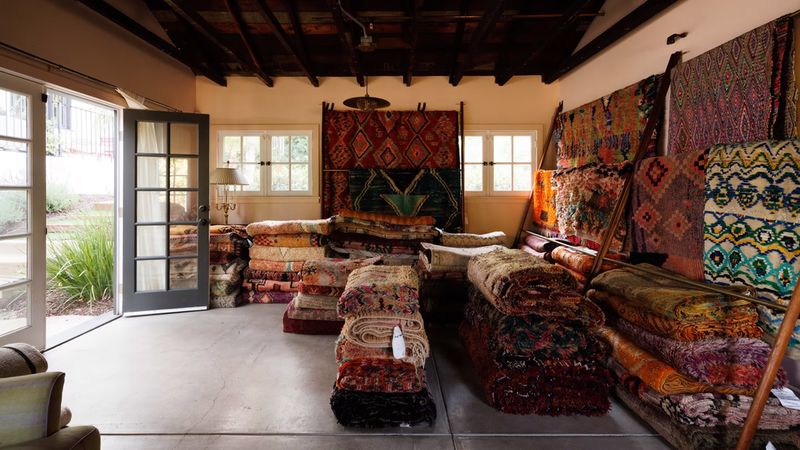
What had previously functioned partly as a guesthouse and workout space has become Ellison’s design showroom for De Maroc, her collection of vintage Moroccan rugs.
The transformation makes practical sense given the business. De Maroc specializes in one-of-a-kind vintage and antique Moroccan rugs, with pieces selected for their rarity, craftsmanship and distinctive character. The company describes the collection as being shaped by Ellison’s years of travel and sourcing throughout Morocco.
The guesthouse could ultimately serve a different purpose for the next owner.
“You could convert it into a whole apartment, or a studio or a workout room,” Ellison said. “It’s really versatile.”
That flexibility is increasingly valuable in Los Angeles, where detached secondary spaces can function as guest accommodations, offices, creative studios, wellness rooms or private living quarters.
The property also includes a detached three-car garage positioned at the end of a long private driveway. According to Coke, the garage was added by a previous owner.
A Private Los Feliz Retreat
Despite its relatively central Los Angeles location, the Nottingham Avenue residence is designed to feel secluded.
The property has a gated entry and walled front garden, with mature hedges and established landscaping creating separation from the street.
“It’s all landscaped. It’s all beautiful and manicured, with big hedges and mature landscaping, so you’re not seeing anyone and no one is seeing you,” Coke said.
That privacy is especially meaningful on Nottingham Avenue, where larger homes and mature lots give the street a distinctly residential character.
The residence also has a swimming pool and landscaped rear grounds, providing the kind of indoor-outdoor environment associated with classic Los Angeles living.
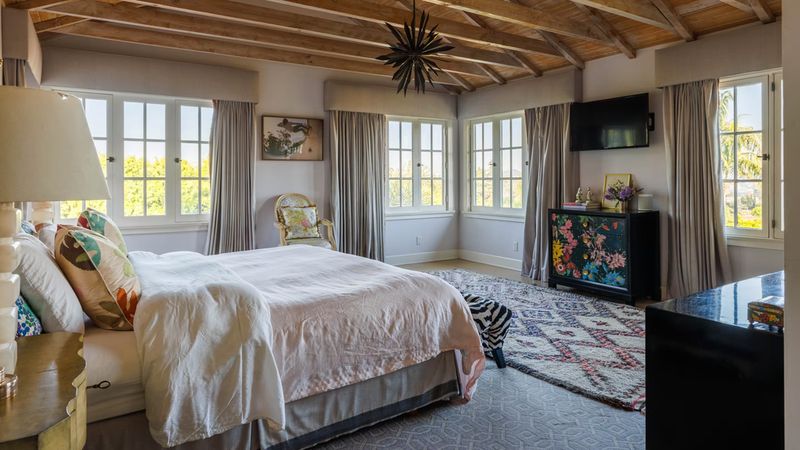
Upstairs, all of the bedrooms are grouped together, including the primary suite. The primary bedroom features a walk-in closet and views toward downtown Los Angeles.
Coke described the outlook as particularly compelling after dark.
The primary suite has “great views of downtown,” she said. “At night, you have the city lights twinkling. It’s very peaceful.”
For Ellison, the elevated perspective creates a different sensation altogether.
“I feel like I’m in a little treehouse,” she said.
A Family Room in Royal Blue and Kelly Green
The home’s more intimate spaces are where its colorful personality becomes even more pronounced.
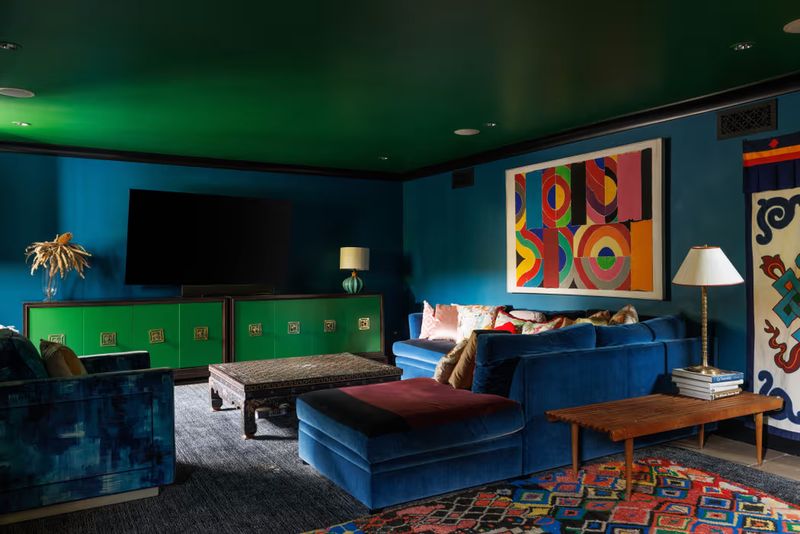
On the lower level, a family and screening room is painted in deep royal blue and Kelly green. The room provides a counterpoint to the more formal spaces upstairs, reinforcing the idea that the property was designed for actual living rather than simply for presentation.
That distinction is part of what makes the house unusual in today’s luxury market.
The residence has formal rooms suitable for entertaining, but also smaller spaces that encourage everyday use. The kitchen, for example, combines dusty lilac cabinetry with an island, stainless-steel appliances and a casual breakfast area.
Coke describes the floor plan as an “old Hollywood classic four-square layout.”
“It’s very grand, yet very intimate,” she said. “You don’t feel like you have to be in a ballgown. It’s very relaxing.”
That combination of grandeur and informality may be one of the strongest selling points of the Michael C. Hall Los Feliz home.
Nottingham Avenue and Los Feliz’s Creative Identity
The property’s address places it within one of Los Angeles’s most recognizable residential neighborhoods.
Los Feliz sits between Griffith Park, Silver Lake, Hollywood and East Hollywood, with a long association with actors, musicians, architects and other creative professionals. The neighborhood’s architectural history includes significant work by figures such as Frank Lloyd Wright, Wallace Neff, Richard Neutra and R.M. Schindler.
Nottingham Avenue itself has become known for larger, architecturally distinctive homes.
“This street is known for being a celebrity enclave,” Coke said. “On this section of Nottingham, every house is grand in nature.”
Ellison offered a similar assessment of the immediate surroundings, calling it one of the premier streets on Los Angeles’s Eastside and noting the concentration of creative residents and substantial homes.
The location also gives residents access to the everyday conveniences that distinguish Los Feliz from more isolated hillside enclaves.
Walkable Dining, Shopping and Griffith Park
One of the property’s advantages is its proximity to the commercial corridors along Hillhurst and Vermont avenues.
The Los Feliz Village area is known for independent restaurants, cafés, boutiques, bookstores and neighborhood businesses, giving residents access to a relatively walkable urban environment despite the area’s large private homes. The Los Angeles Times has previously described Los Feliz Village as one of Los Angeles’s more walkable commercial districts.
More recent neighborhood reporting continues to emphasize the area’s pedestrian-oriented character around Hillhurst and Vermont.
For dining, residents are close to a range of neighborhood institutions, while Hillhurst and Vermont provide everyday shopping and café culture without requiring a trip into central Los Angeles.
Griffith Park is another major attraction. The expansive urban park provides access to hiking trails, the Griffith Observatory, the Greek Theatre and other recreational destinations, giving the neighborhood a rare combination of city access and proximity to open space.
The result is a lifestyle that is difficult to reproduce in newer luxury developments: a historic house, a private garden and pool, established trees, nearby restaurants and boutiques, and one of Los Angeles’s most significant urban parks practically at the neighborhood’s doorstep.
The Numbers Behind the Michael C. Hall Los Feliz Home
The property’s transaction history tells an interesting story.
It first sold in the currently available public record in May 2012 for $2.09 million. It returned to the market the following year and sold in May 2013 for $3.825 million, when Michael C. Hall was reported as the buyer. In March 2016, the residence changed hands again for $4.85 million, the transaction associated with Ellison’s ownership.
The home was subsequently offered at $7.995 million in July 2022, before being removed from the market in September of that year. It returned in 2026 at $6.5 million.
That pricing history places the current offering in a different position from the property’s 2022 attempt. At $6.5 million, the asking price is approximately 18.7% below the 2022 listing price of $7.995 million.
For a property with celebrity provenance, nearly a century of architectural history and a highly personalized interior, the current price also reflects a broader reality of Los Angeles luxury real estate: buyers at the upper end increasingly scrutinize not only the story behind a home, but whether the asking price aligns with the property’s physical attributes and current market conditions.
A Los Feliz Home That Refuses to Look Like Everything Else
The most compelling aspect of 2230 Nottingham Avenue may ultimately have little to do with Michael C. Hall.
Celebrity ownership provides an intriguing footnote, but the home’s current identity comes from something more enduring: architecture, landscape and design.
The 1923 Spanish-style structure retains the proportions and character of an older Los Angeles residence, while Ellison’s use of color and Moroccan textiles has given the interiors an unmistakably personal voice.
It is a house that does not attempt to look new.
Instead, it leans into history and personality.
For California Luxury Houses, that makes the property particularly representative of the kind of Los Angeles luxury home that continues to command attention: not simply a large residence with expensive finishes, but a home with a recognizable identity, a documented history and a sense of place.
At $6.5 million, the Michael C. Hall Los Feliz home is now waiting for its next chapter—and whoever acquires it will inherit considerably more than the walls and acreage of a 1923 residence. They will also inherit a piece of Los Feliz’s long-running conversation between Hollywood, architecture and creative life.
Property Details
The residence at 2230 Nottingham Avenue in Los Angeles’s Los Feliz neighborhood was built in 1923 and sits on approximately 0.35 acres. Current listing materials describe 5,618 square feet of living space, five bedrooms, five full bathrooms and one partial bathroom. The property includes a swimming pool, detached guesthouse, detached three-car garage, landscaped gardens, two fireplaces and gated entry.
The property is currently offered at $6.5 million by Sonya Coke of Sotheby’s International Realty – Los Feliz Brokerage.