

Before it became Mr. Bingley’s fictional residence in one of television’s most recognizable literary adaptations, Edgcote Estate had already spent centuries writing its own story. Long before cameras arrived in Northamptonshire, the land had passed through royal ownership, witnessed political conflict and evolved into one of England’s most significant country estates.
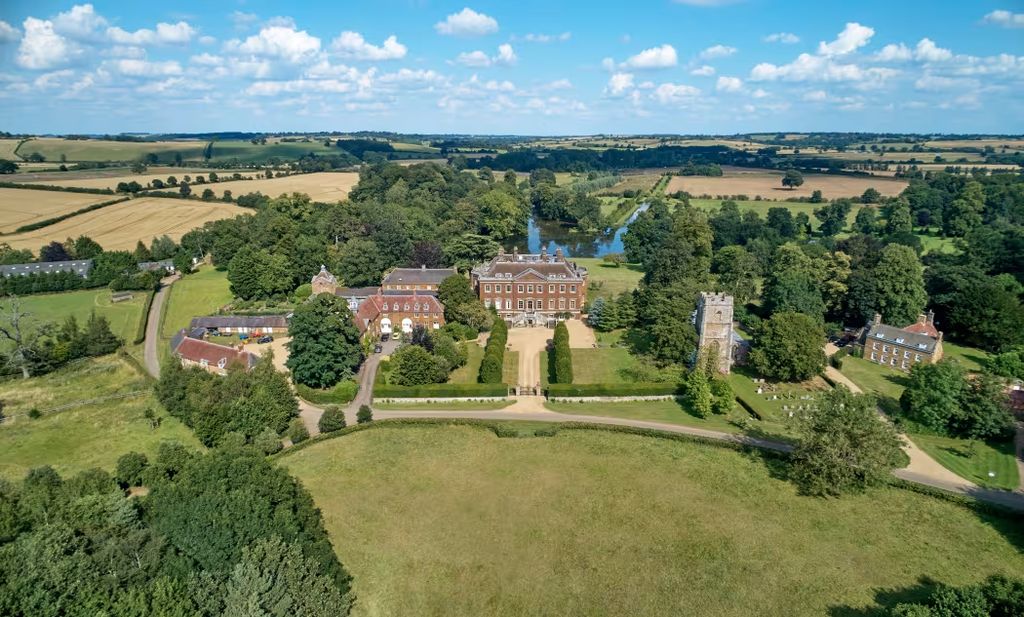
Now, Edgcote Estate has entered the market with a guide price exceeding £45 million, bringing with it approximately 1,704 acres of land, a Grade I-listed Georgian mansion and a history that stretches back nearly a thousand years. For buyers seeking more than square footage and amenities, the offering represents a rare opportunity to acquire an estate where architecture, heritage and cultural recognition intersect.
Edgcote Estate is located in Northamptonshire near Banbury and remains widely recognized as the filming location used as Netherfield Park in the BBC’s 1995 adaptation of Pride and Prejudice. The six-part television series starring Colin Firth and Jennifer Ehle introduced the property to audiences around the world, though its historical significance predates its television fame by many centuries. Pride and Prejudice Colin Firth
The History Behind Edgcote Estate and Its Royal Connections
Following the Norman Conquest, ownership of the land that would later become Edgcote Estate was granted to Geoffrey of Mowbray. Over the centuries, the property passed through various periods of private and royal ownership before eventually returning to the Crown during the early fourteenth century.
Historical records also associate the grounds with the Battle of Edgcote, a conflict connected to the broader struggle for power during the Wars of the Roses.
Edgcote Estate later became connected to one of England’s most recognizable royal figures. Following the annulment of her marriage to Henry VIII in 1540, Anne of Cleves reportedly received ownership rights to Edgcote Estate among the properties granted as part of her settlement agreement.
The present Edgcote House itself was constructed between 1748 and 1754 and remains one of the most important Georgian residences in the region. Its Grade I designation places it among a very small percentage of protected historic buildings in the United Kingdom, a classification reserved for properties considered architecturally and historically exceptional.
According to materials reviewed by californialuxuryhouses, long-term stewardship rather than dramatic reinvention appears to have guided much of the estate’s preservation.
Why Edgcote Estate Became the Famous Pride and Prejudice Filming Location
Long before social media transformed filming locations into tourist destinations, Edgcote Estate had already become familiar to millions of viewers through one of television’s most beloved literary adaptations.
The property’s authentic Georgian architecture made it a natural fit for producers of the BBC’s 1995 Pride and Prejudice series. Viewers of the six-episode production immediately recognize the estate as Netherfield Park, the elegant residence occupied by Charles Bingley, whose arrival becomes one of the story’s central turning points.
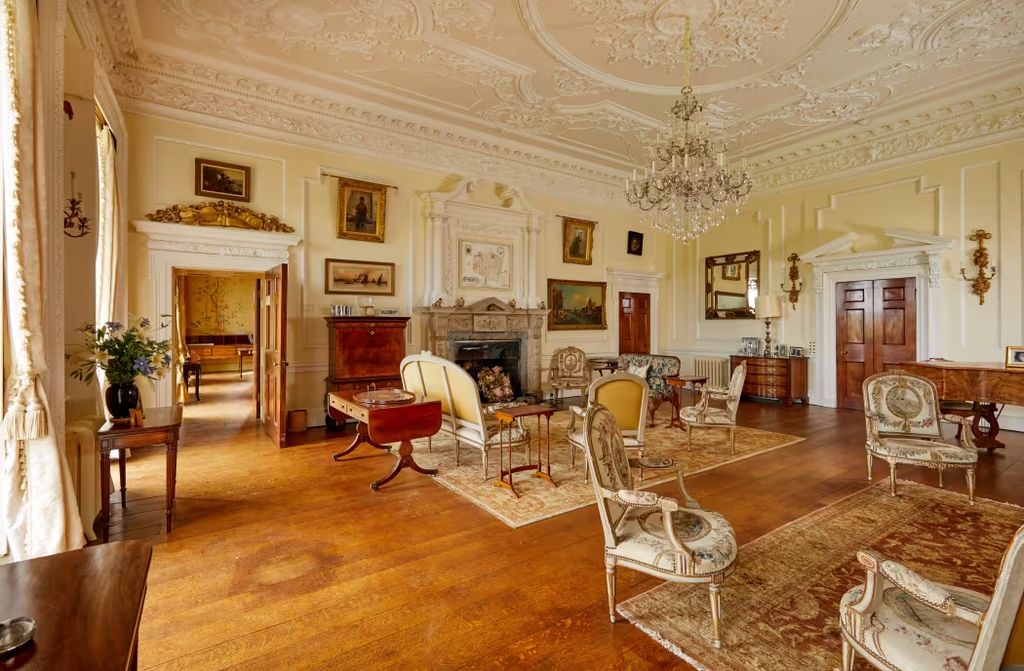
Unlike productions that require extensive set construction or digital enhancement, Edgcote Estate offered authenticity that already existed. Classical proportions, grand reception rooms and period detailing helped create a setting that felt naturally aligned with the world imagined by Jane Austen.
Luxury Houses reviewed available historical coverage surrounding the filming history, though additional archival production details remain limited in public records.
Inside Edgcote Estate’s Grade I-Listed Georgian Mansion
Inside, Edgcote Estate unfolds across approximately 25,908 square feet distributed throughout four principal levels. Rather than relying on excess, the interiors emphasize craftsmanship and proportion.
Historic Details and Original Craftsmanship
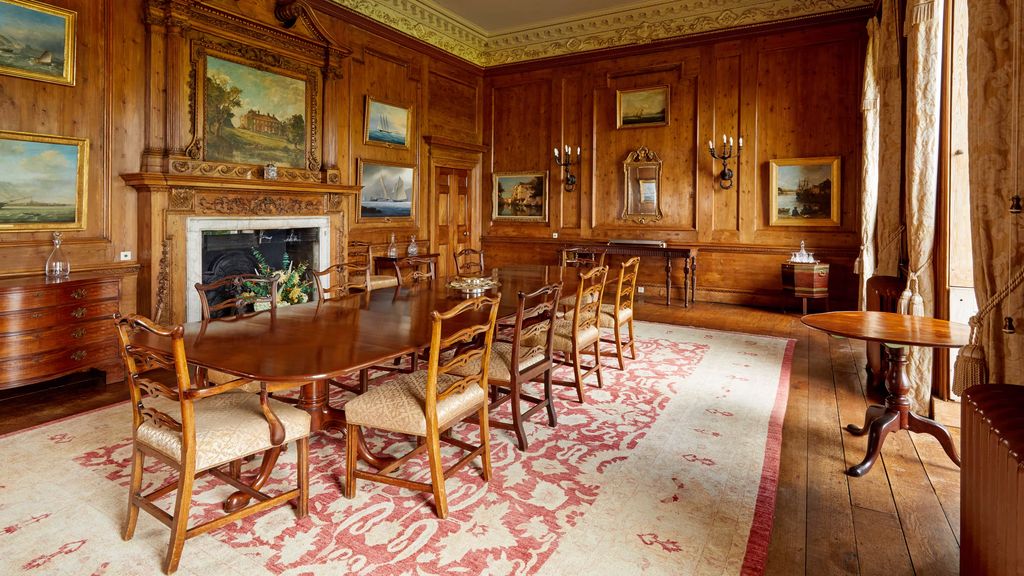
Decorative plasterwork, elaborate cornicing and carved fireplace surrounds continue throughout many of the principal rooms. Traditional wood paneling introduces warmth and texture, while historic architectural elements reinforce the property’s identity.
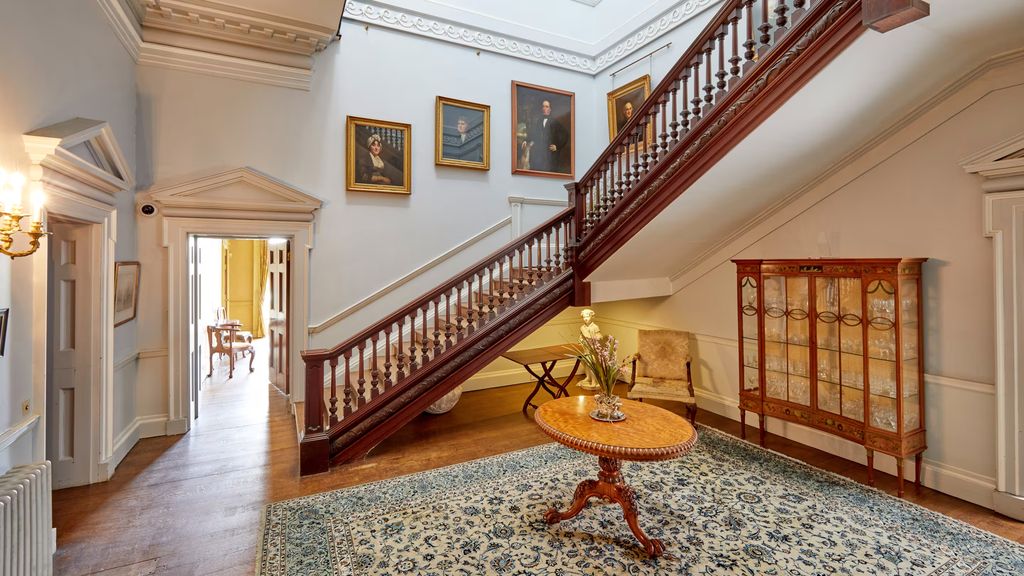
Among the home’s most recognizable features is a dramatic open-well mahogany staircase that rises through the interior with sculptural elegance. Rather than functioning purely as a practical element, the staircase acts almost as an architectural centerpiece connecting the residence vertically.
Views Across Gardens and Estate Grounds
Large windows throughout Edgcote Estate create changing patterns of light while framing views across formal landscapes and surrounding countryside.
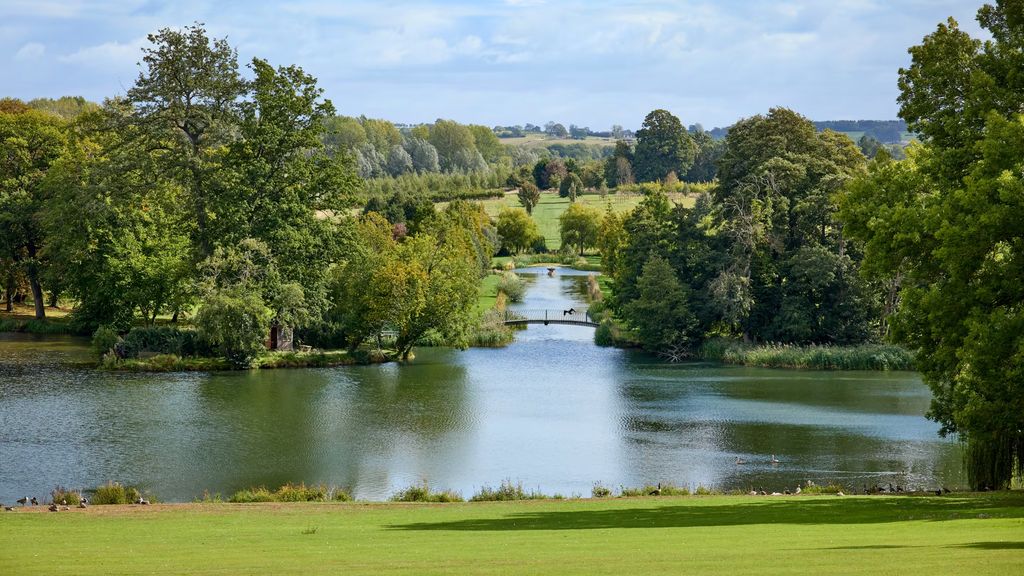
From various points inside the residence, sightlines extend toward the property’s manicured gardens, open parkland and an approximately 8.6-acre lake that contributes to the visual identity of the grounds.
Edgcote Estate Includes Farmland, Equestrian Facilities and Historic Buildings
Beyond the principal residence, Edgcote Estate functions almost as a private world of its own.
The broader property includes approximately 1,149 acres of productive farmland together with woodland, landscaped gardens and open countryside. More than thirty houses, cottages and apartments are distributed throughout the estate, alongside additional historic structures including a Grade II-listed rectory and traditional mill buildings located near the River Cherwell.
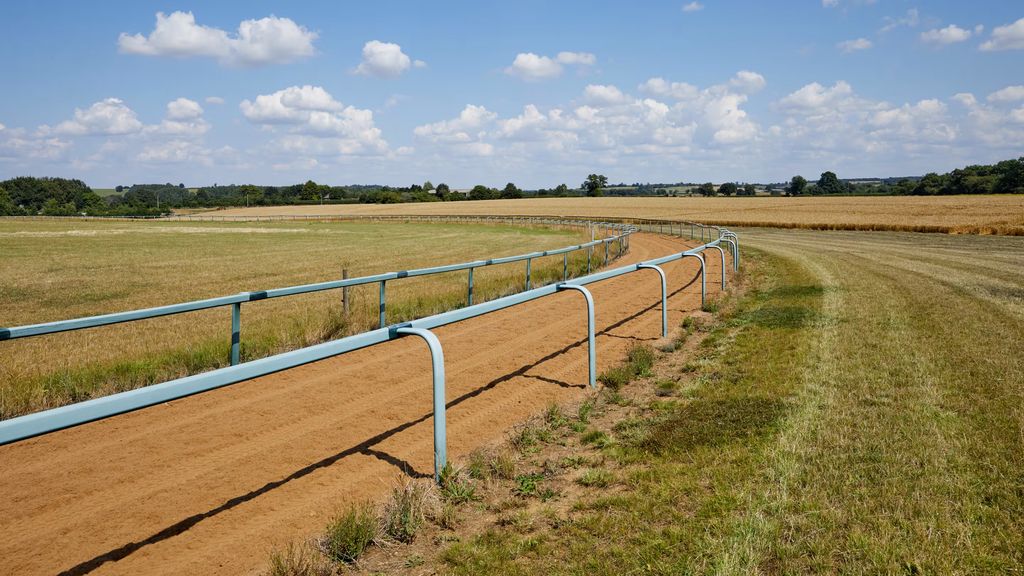
Equestrian infrastructure contributes another important layer of functionality. Professional racing yards, paddocks and gallops form part of the property’s broader sporting facilities, while a racecourse originally established during the 1920s later underwent refurbishment in 2018.
Large estates increasingly attract buyers seeking flexibility beyond residential use. Agricultural production, sporting pursuits and long-term land ownership strategies have become important considerations within today’s ultra-prime market.
Ownership History and the Legacy of Edgcote Estate
Luxury Houses reviewed publicly available ownership information and found that the property is currently being offered by the estate of businessman David Allen.
Reports indicate that Allen acquired Edgcote Estate in 2005 and dedicated substantial effort toward preserving and managing the property until his death in 2015 at age eighty-three. Public records surrounding the acquisition price have not been widely disclosed.
Rather than pursuing major contemporary redevelopment initiatives, ownership appears to have focused on maintaining the property’s historical integrity.
Northamptonshire Lifestyle, Transportation and Local Amenities
Beyond architecture and history, location continues to influence buyer decisions in the luxury market.
Northamptonshire has increasingly appealed to buyers seeking privacy without complete isolation. Connections toward London, Birmingham and Oxford support accessibility, while nearby communities offer restaurants, shopping destinations and everyday services.
The broader region also maintains a strong reputation for equestrian traditions, countryside activities and historic village environments that continue attracting domestic and international buyers interested in long-term lifestyle value.
Why Edgcote Estate May Appeal to Today’s Luxury Buyers
For television audiences, Edgcote Estate may remain permanently associated with Mr. Bingley and Jane Austen’s fictional world. For historians, it represents nearly one thousand years of English heritage.
For today’s luxury buyer, however, Edgcote Estate may ultimately represent something more difficult to replicate: a property where architecture, land, cultural identity and historical significance coexist within a single offering.
At more than £45 million, Edgcote Estate enters the market not simply as a real estate transaction, but as the next chapter of a legacy that has already endured for centuries.