

More than two and a half centuries after King George III commissioned it for one of the most celebrated astronomical events of the 18th century, the King’s Observatory in Richmond has entered the luxury property market as a private family residence priced at £18 million.
Built in 1769 by architect Sir William Chambers, the Grade I-listed landmark was created so George III, Queen Charlotte and members of the royal household could observe the transit of Venus across the sun. Today, the historic observatory has been transformed into a four-bedroom residence spanning approximately 7,343 square feet, surrounded by about 6.59 acres of private grounds in Old Deer Park.
For californialuxuryhouses, the appeal of the property lies in the unusual collision of royal history, scientific heritage and contemporary family life. It is not simply an old building adapted for residential use; the observatory retains architectural elements and scientific remnants that connect the house directly to its original purpose.
A Royal Observatory Designed for the Transit of Venus
The story begins with George III’s fascination with science and astronomy. Sir William Chambers, one of the leading architects of Georgian Britain, designed the observatory in the grounds of the royal estate at Richmond.
Completed in time for the June 3, 1769, transit of Venus, the building’s defining feature remains its telescope cupola. The revolving structure was designed to allow astronomical observations and continues to crown the residence more than 250 years later.
Chambers was also responsible for major works including Somerset House, giving the King’s Observatory an architectural pedigree that extends well beyond its royal association. The building was subsequently used for scientific and meteorological work for generations, eventually becoming associated with some of Britain’s most important developments in weather observation.
Listing agent Charlie Willis has emphasized the unusual nature of the opportunity, describing the property’s provenance and residential transition as particularly significant.
“The national importance [of this listing] is truly remarkable, let alone the location and the fact that this is the first time since 1769 that the building will be sold for residential use.”
Willis has also highlighted the potential for a future owner to expand the residence by as much as 10,000 square feet, subject to the permissions already associated with the property.
From Scientific Institution to a Four-Bedroom Family Home
The observatory’s residential chapter is relatively recent.
Historical records show that the building was refurbished for office use in the 1980s, and from 1986 until 2011 it was occupied by Autoglass, which used it as its UK headquarters. Robbie Brothers, a Hong Kong-based property developer with an interest in historic buildings, has held the lease through Kew Holdings since 1989. Planning permission for conversion to a private single-family residence was granted in 2014, while the major restoration was completed in 2018.
Brothers has described his first encounter with the property as an immediate attraction to its Georgian symmetry and architectural history. His restoration philosophy was equally clear: rather than erase the building’s past beneath contemporary finishes, he wanted to recover as much of its original character as possible.
The result is a residence where historic and modern elements coexist.
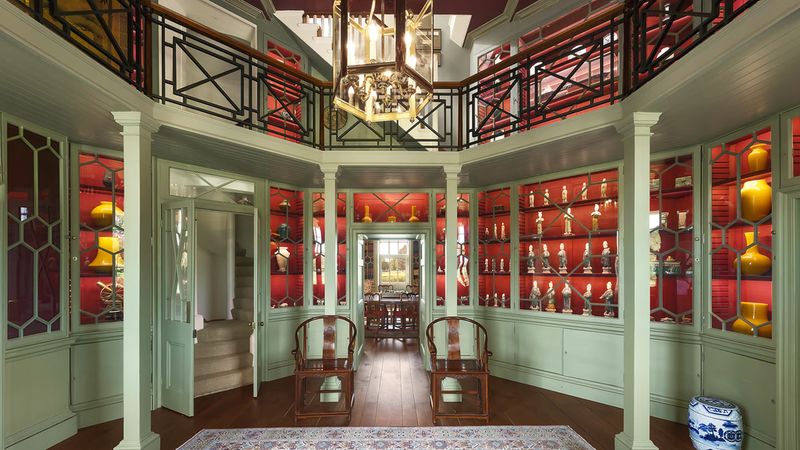
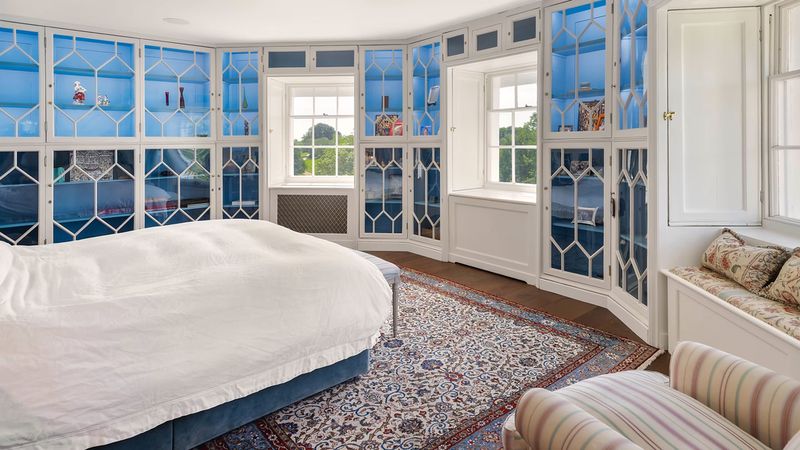
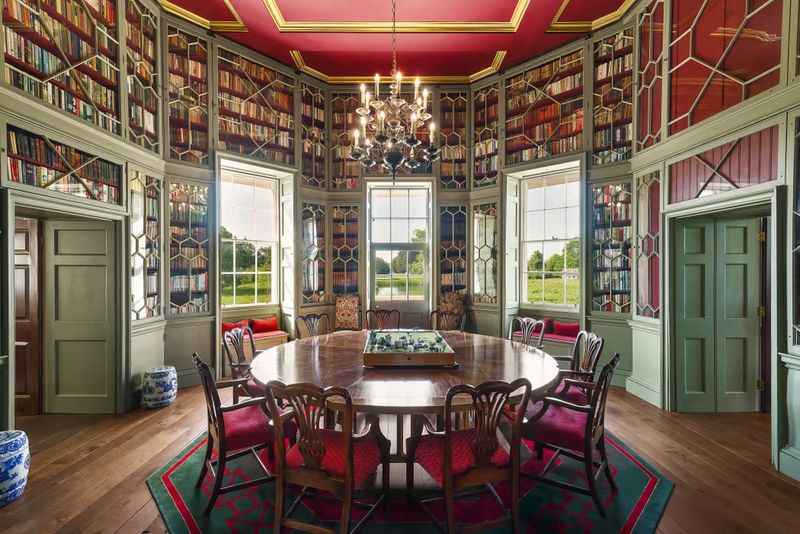
The original scientific character remains visible in several rooms. A library occupies what was once the computing room and can accommodate roughly 6,000 books. The former barometer room has become a formal dining room, while the property’s octagonal rooms retain historic display cabinets associated with its scientific past.
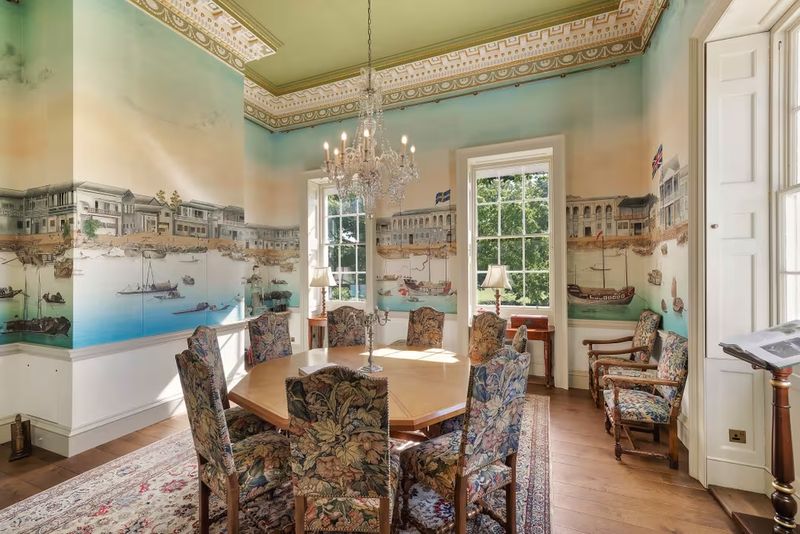
The dining room introduces a more decorative layer, with hand-painted Chinoiserie wallpaper inspired by an 18th-century China Trade view. According to the listing material, the painstaking work took almost 5,000 hours to complete.
Georgian Grandeur Meets Contemporary Family Life
Despite its institutional and royal origins, the house is now configured around everyday family living.
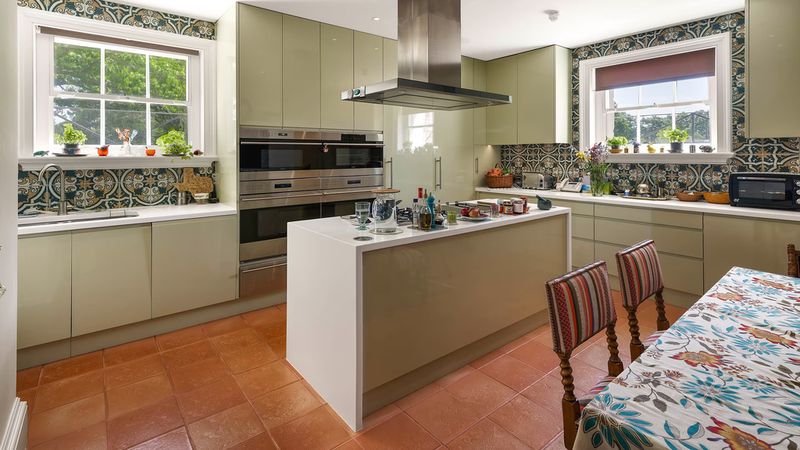
The present accommodation includes four bedrooms and four bathrooms, with principal bedroom suites, dressing rooms and marble bathrooms arranged across the upper levels. A lift serves all three residential floors, while a dumbwaiter connects the kitchen with the dining room and bedroom level. Modern infrastructure, including underfloor heating, air conditioning, security systems and automated controls, has been integrated discreetly into the historic structure.
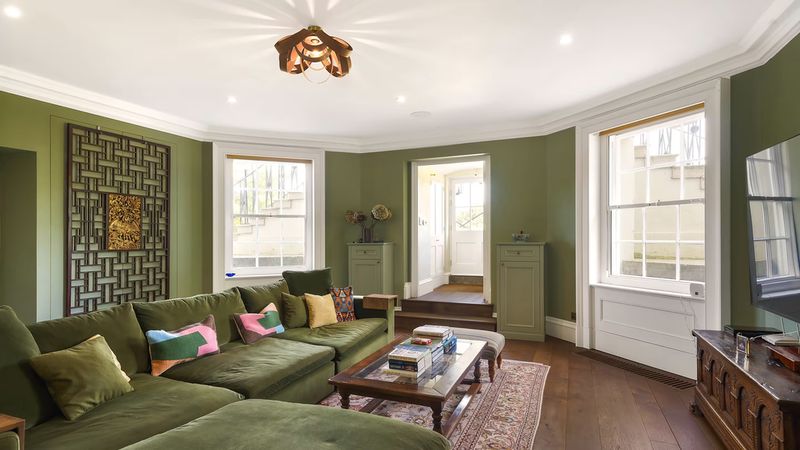
The living spaces retain the extraordinary proportions one might expect from a Georgian royal building. The triple-aspect living room, tall sash windows and ceilings approaching 30 feet create an interior that remains grand without functioning like a museum.
Patrick Brothers, son of the current owner, has described the house as both historically imposing and practical for family life.
“Thirty-foot ceilings and sash windows looking out onto the golf course provide an excellent backdrop in which to work and entertain.”
That distinction is important. The property’s present identity comes not from preserving it behind glass, but from allowing a family to occupy a building whose original purpose was very different.
A Historic Landscape With Its Own Lake
Outside, the King’s Observatory occupies a setting that feels unusually removed from metropolitan London.
The property sits within Old Deer Park, a historic landscape connected to Richmond Palace and still associated with the Crown. Parts of the surrounding landscape carry Scheduled Monument status, while the wider setting reflects the influence of 18th-century landscape designer Lancelot “Capability” Brown. The current owner commissioned landscape architect Kim Wilkie to reinterpret elements of that historic landscape while preserving its character.
The grounds include an ornamental lake, a Portland stone boathouse and the surviving anti-magnetic huts associated with the observatory’s scientific history. The residence is also surrounded by the Royal Mid-Surrey Golf Club, adding another layer of open green space and privacy.
The listing further notes planning permission for substantial additional accommodation. If fully realized, the proposed expansion could add approximately 10,000 square feet, together with staff accommodation and underground parking for as many as 17 cars.
That potential gives the property an unusual second life: the next owner would not necessarily be inheriting a finished historic residence, but a carefully controlled opportunity to enlarge it while retaining its protected architectural fabric.
A Property Connected to the History of D-Day
The observatory’s story extends beyond astronomy.
One of the most consequential chapters in its history concerns meteorology and James Stagg, the Scottish meteorologist who became chief meteorological adviser to Gen. Dwight D. Eisenhower during the Second World War.
Stagg’s weather forecasts played an important role in Allied planning for the D-Day landings in June 1944. His advice contributed to the decision to postpone the invasion from June 5 to June 6, when commanders believed conditions offered a more viable window.
A plaque bearing Stagg’s name remains associated with the property, linking the Georgian observatory to one of the defining military operations of the 20th century. The episode has also recently received renewed public attention through the film Pressure, which dramatizes the relationship between Stagg and Eisenhower.
For a private residence, that is an unusually deep historical timeline: royal astronomy in the 1760s, scientific research through the 19th and 20th centuries, wartime meteorology, commercial use and, finally, contemporary family life.
Old Deer Park and the Richmond Lifestyle
The property’s secluded setting does not mean isolation.
Old Deer Park sits immediately within the Richmond and Kew area, giving residents access to the cultural, dining and recreational infrastructure of southwest London. Richmond station provides South Western Railway, London Underground District line and London Overground connections, while local bus routes serve the surrounding district.
The wider neighborhood also benefits from its proximity to the Royal Botanic Gardens, Kew, the River Thames and Richmond’s town center. Kew Gardens, historic Kew Palace and other cultural destinations are within the surrounding area, while Richmond provides restaurants, independent shops and everyday services alongside its riverside setting.
Road connections are similarly established, with the A316 providing access toward central London and the M3 and M25 network. The property’s listing also highlights its relatively convenient access to central London and Heathrow Airport, while the estate itself has a private helipad.
For a buyer seeking a large historic residence outside central London, that combination is significant. The observatory offers the atmosphere of a country estate while remaining connected to one of the world’s major cities.
A 250-Year Story Enters Its Next Chapter
The King’s Observatory is now being offered at £18 million, with the lease extending for approximately another 138 years according to current listing information. The property is being marketed through luxury agents including Charlie Willis, with the residence offered as a rare combination of protected architecture, private grounds and contemporary family accommodation.
Publicly available records reviewed by californialuxuryhouses show that the property’s modern transformation has been a long process rather than a recent cosmetic conversion. Brothers’ lease dates back to 1989, planning permission for residential use arrived in 2014, and the principal restoration was completed in 2018.
That timeline helps explain what makes the £18 million listing unusual. The next owner would not simply be purchasing a luxury home in Richmond. They would be taking custody of a building that has moved through royal astronomy, scientific research, meteorology, wartime history and modern family life—and still retains the physical architecture that connects those chapters.
For californialuxuryhouses, few contemporary luxury listings illustrate the idea of living history quite as literally as the King’s Observatory.