

A small Manhattan residence associated with Jackson Pollock’s formative years is returning to the real estate market with an asking price of $1.99 million, offering buyers a rare opportunity to own a piece of Greenwich Village’s artistic history.
Located at 46 Carmine Street, the top-floor condominium occupies an 1827 Federal-style townhouse where Pollock lived with his older brother, Charles, and sister-in-law, Elizabeth, in the early 1930s. Long before his energetic drip paintings helped redefine postwar American art, Pollock was a young artist still developing his voice in New York. The apartment reportedly served as both a home and a place to work during this early chapter of his career. MoMA’s chronology and local preservation records document Pollock’s connection to the address.
Now measuring approximately 690 square feet, the one-bedroom, one-bathroom residence combines exposed brick, a working fireplace, skylights and an open loft with contemporary updates. Its current owner, entrepreneur and investor Fergus Hurley, has also introduced artwork inspired by the home’s creative past. The result is a property whose appeal extends beyond its relatively modest footprint: its story is woven into the cultural history of one of Manhattan’s most distinctive neighborhoods. Listing details and recent coverage.
A Greenwich Village Townhouse With an Artistic Past
Built in 1827, the brick townhouse at 46 Carmine Street predates Pollock’s arrival in New York by more than a century. Its traditional Federal-style architecture reflects an earlier period in the city’s development, when low-rise residential buildings formed the fabric of neighborhoods that would later become celebrated for their artistic communities.
Pollock moved into the residence in 1932, during a period of study and experimentation. He had come to New York to pursue art and studied under influential painter Thomas Hart Benton at the Art Students League. Although Benton’s approach differed markedly from the abstraction for which Pollock would eventually become known, those early years helped shape the artist’s development.
The Carmine Street home belongs to a wider Greenwich Village story. The neighborhood has long attracted painters, writers, musicians and other creative figures, drawn by its intimate streets, independent cultural venues and distance from the more formal rhythms of Midtown. Pollock lived at several Village addresses during his years in New York, making the surviving Carmine Street townhouse one part of a broader record of his early life.
The building’s own history continued well beyond Pollock’s residence. It underwent changes in use and configuration over the decades before becoming part of the area’s protected architectural heritage. In 2010, 46 Carmine Street and its surroundings were included in the Greenwich Village Historic District Extension II, also known as the South Village extension. The property was subsequently listed on the State and National Registers of Historic Places in 2013, according to Village Preservation.
Skylights, Exposed Brick and a Loft-Like Interior
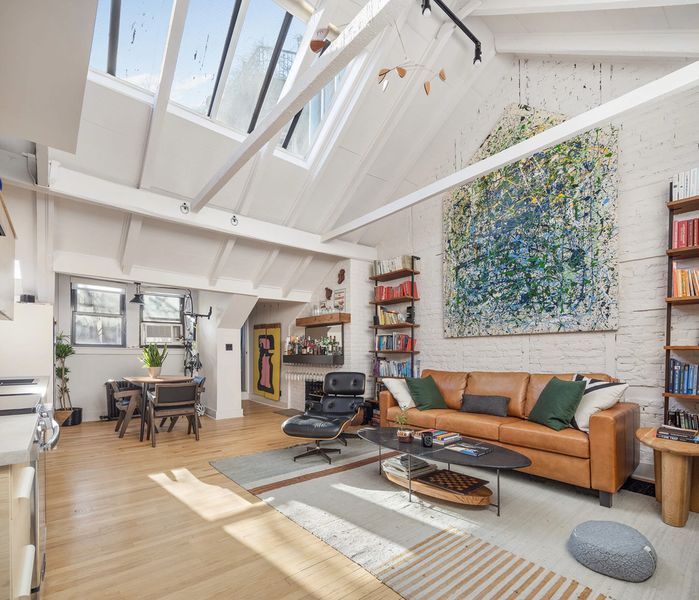
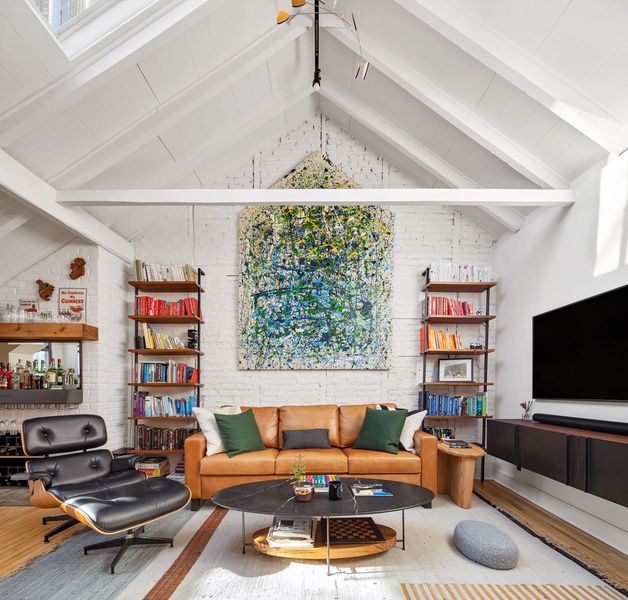
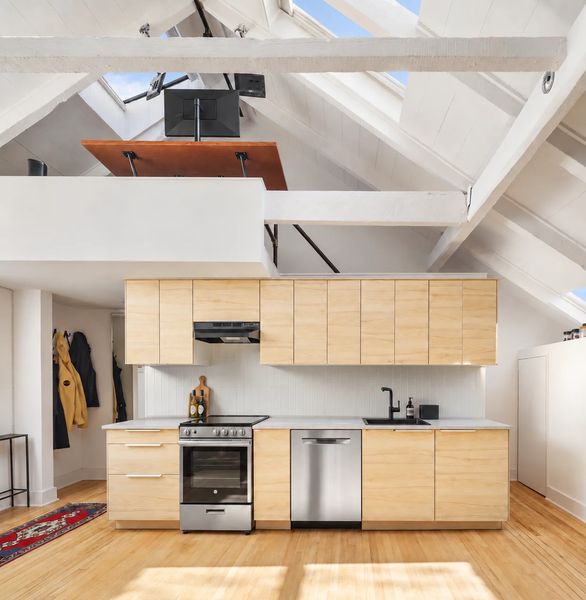
Inside, the apartment’s defining feature is its sense of openness. The main living and dining area sits beneath a vaulted ceiling with exposed, white-painted beams and brickwork. A substantial skylight introduces natural light along the roofline, giving the top-floor space a brighter and more expansive feel than its compact dimensions might suggest.
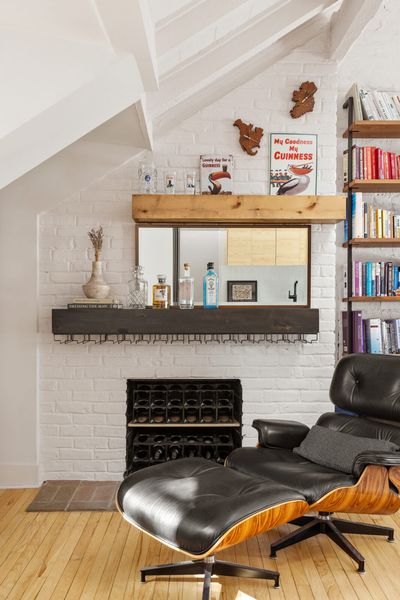
The original materials supply much of the home’s character. Exposed brick and a working fireplace anchor the living area, while wide-plank wood flooring and visible beams add texture. The combination avoids the polished uniformity of a newly built condominium, instead preserving details that connect the interior to the townhouse’s long history.
A large abstract painting inspired by Pollock hangs above a leather sofa. The work has a story of its own: it was made using wooden boards that had covered a SoHo storefront during the 2020 protests following George Floyd’s killing. The piece links the home’s artistic legacy with a more recent chapter in New York’s social and cultural life.
The kitchen opens directly onto the main living area. Light-toned wood cabinetry runs along the wall, with the cooking appliances and sink integrated into a practical layout. The arrangement makes efficient use of the available space while keeping the kitchen connected to the apartment’s principal gathering area.
Above it, an open loft overlooks the living room. Currently configured as a home office, the elevated space provides room for focused work without closing off the main floor. It could also accommodate creative projects or serve as a flexible retreat, subject to the home’s physical layout and applicable building requirements.
A Private Bedroom and Contemporary Bathroom
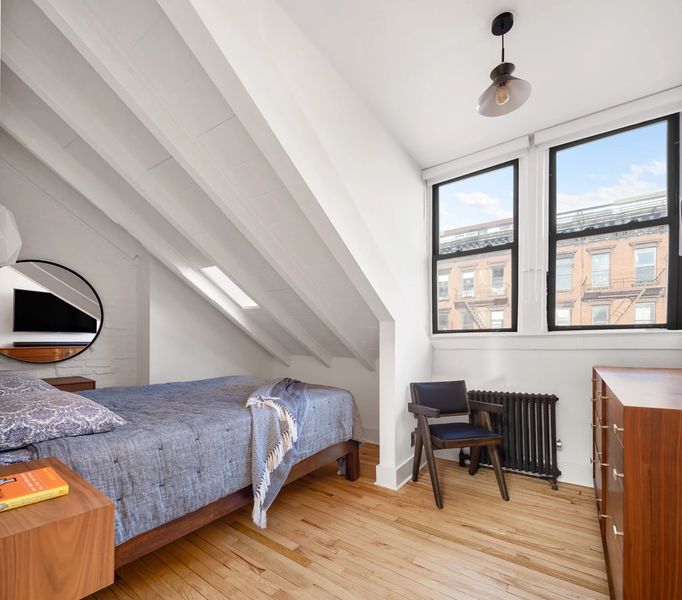
The apartment’s bedroom sits beneath the sloping roofline, where a skylight and windows bring daylight into the more intimate space. An exposed, white-painted brick wall continues the material palette found in the living area, while the roof angles give the room a tucked-away quality.
The bathroom is compact and finished with blue tile extending through the walk-in shower. A sliding glass door separates the shower area, with the vanity and toilet positioned opposite. The design introduces a more contemporary finish while maintaining the apartment’s efficient use of space.
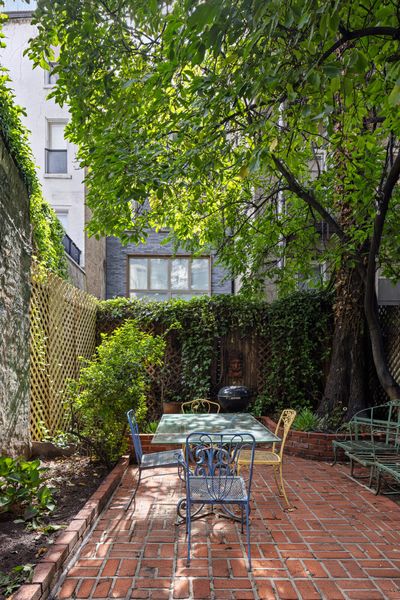
Residents also have access to a shared rear garden with outdoor seating and a grill. In a dense Manhattan neighborhood, this communal outdoor area provides a useful counterpoint to the apartment’s interior footprint, offering a place to sit outside without leaving the building.
Fergus Hurley’s Modern Interpretation of the Home
The apartment’s current owner, Fergus Hurley, purchased the residence off-market in 2021 after first renting it. According to published reporting, Hurley moved from Ireland to New York in 2020 to work with Google’s startup ecosystem, and the apartment’s loft became a practical work-from-home space during the pandemic.
He has also continued the property’s association with creative work through art and design. In addition to the Pollock-inspired painting, a wooden beam removed during renovation was transformed into a guitar by Carmine Street Guitars, a neighborhood workshop known for its handcrafted instruments. These details give the residence a contemporary identity without severing its connection to the past.
“There’s something inspiring about creating something new in a 199-year-old building that Jackson Pollock once called home,” Hurley told ELLE Decor, describing the personal connection he developed with the property. The published interview also details his work on the large painting made in the garden.
The apartment’s next owner will inherit both the preserved architectural details and the more recent additions that reflect Hurley’s approach to the space.
West Village Living Beyond the Front Door
The home sits between Bedford and Bleecker streets in Greenwich Village, an area valued for its human-scale streetscape, independent businesses and established cultural life. The surrounding neighborhood offers restaurants, cafés, intimate performance venues and music destinations that contribute to the Village’s long-standing appeal.
Washington Square Park, one of downtown Manhattan’s best-known public spaces, is part of the wider neighborhood experience. The area also offers access to the city’s broader cultural institutions and employment centers by public transportation. For buyers drawn to historic Manhattan, the location combines the character of a low-rise residential street with the convenience of a central urban setting.
Unlike larger luxury apartments that emphasize extensive amenities or panoramic views, this property sells a more personal idea of New York living. Its appeal rests on architectural character, a compact loft-like layout and a documented connection to an important figure in American art.
A $1.99 Million Listing With a Distinctive Legacy
The residence is asking $1.99 million, according to current listing information, and is represented by Shane Boyle of Compass. The price places the emphasis not on size but on location, historic character and the property’s association with Pollock.
Public property records and listing histories provide some context for its market journey. The apartment was listed for $1.25 million in 2014 and recorded a sale at approximately $1.46 million that October, according to StreetEasy. Hurley later purchased the home in an off-market transaction in 2021; the publicly available coverage reviewed for this article does not establish the purchase price. The new asking price should therefore be understood as a current seller’s target, not as a confirmed valuation or completed sale.
For readers following historic residences and culturally significant properties, californialuxuryhouses sees this listing as a reminder that real estate value can come from more than floor area alone. At 46 Carmine Street, a compact home brings together the enduring fabric of a 19th-century townhouse, the creative history of Greenwich Village and an interior adapted for contemporary life.
Pollock’s time in the apartment belongs to the early, uncertain stage of a career that would later transform modern painting. The home does not tell his entire story, but it preserves a tangible connection to the period when that story was still taking shape. Now on the market again, the residence offers a new buyer the chance to become part of the next chapter in a building that has been reinventing itself for nearly two centuries.