

Taylor Swift and Travis Kelce’s newly acquired Ohio estate has an architectural counterpart nearly 375 miles away in Wheaton, Illinois, where a remarkable Gilded Age mansion has returned to the market for $1.75 million.
Known as the House of Seven Gables, the three-story residence at 141 Loretto Court was completed in 1897 for Chicago steel and iron magnate Jay C. Morse. Designed by architect Jarvis Hunt, the 10,000-square-foot mansion was conceived decades before Morse commissioned another Hunt-designed residence in Bratenahl, Ohio, that would eventually become the historic estate purchased by Kelce.
The connection gives the Illinois property an unusual place in the current luxury real-estate conversation. While the Wheaton house is not owned by Swift or Kelce, its architectural lineage is directly tied to the Ohio mansion that has recently become the couple’s new home.
According to current listing records, the House of Seven Gables is being offered for $1.75 million through Jennifer Ames and Lisa Grimes of Engel & Völkers Chicago.
A Mansion Built for a Chicago Industrial Magnate
The story of 141 Loretto Court begins during the Gilded Age, when Wheaton was home to an enclave of substantial country estates associated with the nearby Chicago Golf Club.
Morse commissioned Jarvis Hunt to create the residence in 1897, with the National Register of Historic Places identifying the House of Seven Gables as a three-story Tudor Revival home. The architect, who was based in Chicago and worked across the Midwest, later designed another residence for Morse after the industrialist returned to the Cleveland area.
That second house, known as Moyenage, now stands on Lake Shore Boulevard in Bratenahl overlooking Lake Erie. Kelce purchased the roughly 21,000-square-foot Ohio mansion for $5.35 million in March 2026, according to contemporary reports.
The relationship between the two houses is more than a coincidence of architect and owner.
“The resemblance is really quite remarkable,” Jennifer Ames told Mansion Global.
Historical accounts indicate that Morse wanted his later Ohio residence to draw on the Wheaton house, creating what Ames described as two expressions of a particularly personal architectural vision.
Both properties embrace Tudor and Jacobean influences, with brick exteriors, steep gabled rooflines, prominent chimneys and elaborate interior woodwork. The result is a striking architectural echo between an Illinois historic home now offered for sale and a lakefront Ohio mansion that has suddenly entered the celebrity real-estate spotlight.
The House of Seven Gables Preserves Its Gilded Age Character
At approximately 10,000 square feet, the House of Seven Gables is roughly half the size of Moyenage but retains many of the architectural elements that define its period.
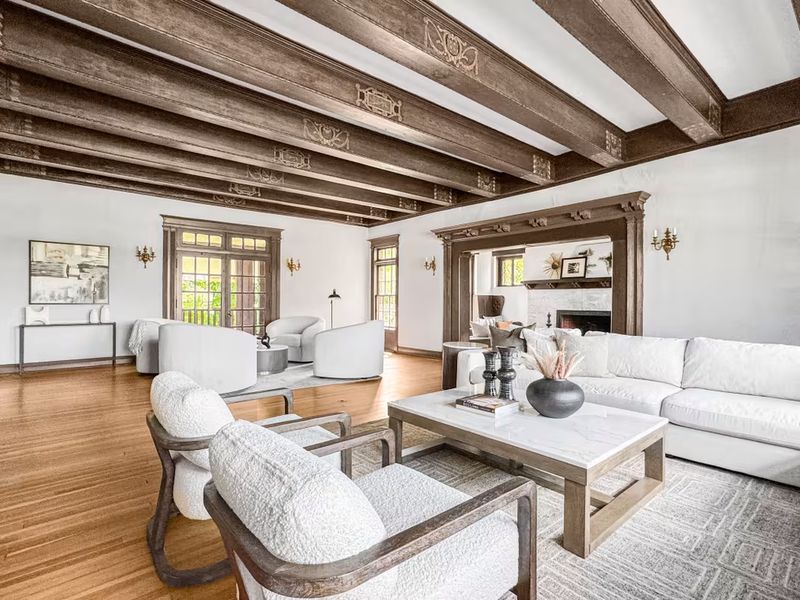
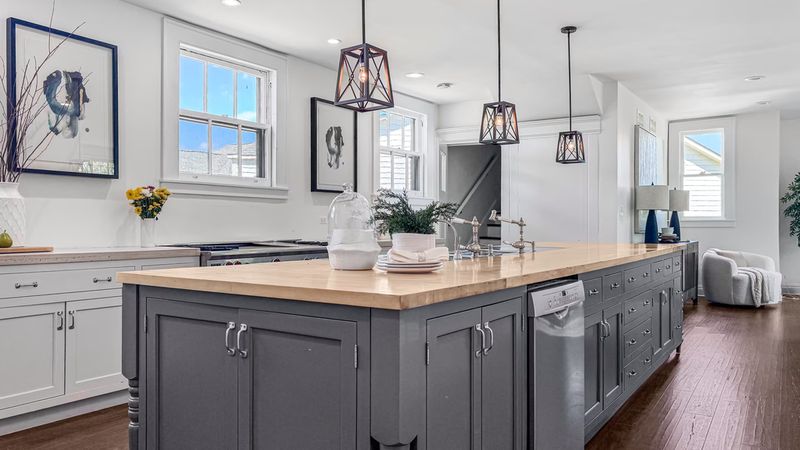
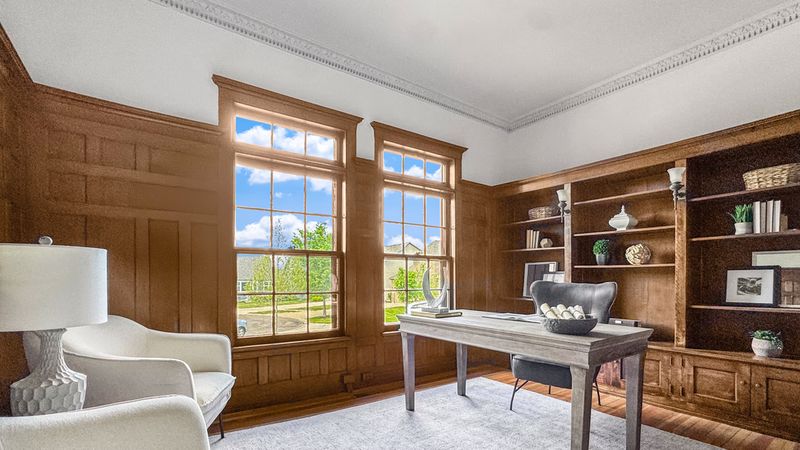
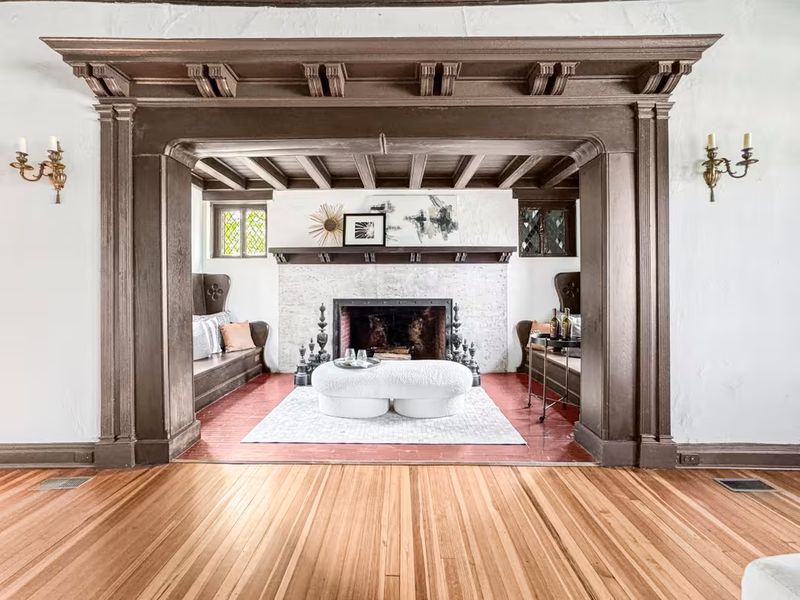
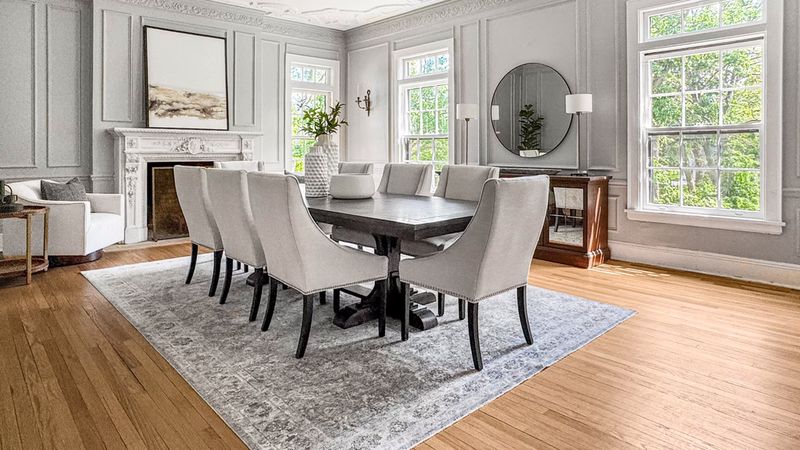
The home has seven bedrooms and six full bathrooms plus a half bath, according to current listing information. A newly built three-car garage adds modern practicality, while the residence itself retains original or period features including oak paneling, carved woodwork, fireplaces, beamed ceilings, substantial staircases and leaded-glass details.
“The interiors are where the relationship becomes especially interesting,” Ames said.
That connection is visible in the way the rooms are organized. Rather than treating historic detailing as decoration applied to an otherwise contemporary floor plan, the house reflects the grand formal planning associated with late-19th-century estates.
Woodwork becomes one of the defining visual elements. Fireplaces anchor formal spaces, while beamed ceilings and paneling give the interiors the darker, richly textured character associated with Tudor Revival architecture.
“There is a richness and almost medieval character to both houses that is unmistakably related,” Ames said.
For a buyer searching for a historic home in Wheaton, that architectural authenticity may be as significant as the number of bedrooms or the size of the lot.
A Historic Home That Was Nearly Lost
Perhaps the most extraordinary chapter in the property’s history came nearly 120 years after its construction.
For decades, the mansion was used as the Loretto Convent. The religious institution occupied the property for roughly 70 years, helping explain why the residence survived with an unusually large amount of historic fabric intact.
That changed when the former convent property became part of a redevelopment plan.
In 2017, the House of Seven Gables faced the possibility of demolition. Instead, preservation efforts resulted in the entire structure being relocated roughly 500 feet to a new site.
Contemporary reporting from the Daily Herald documented the extraordinary operation. The approximately 10,000-square-foot mansion weighed about 729 to 730 tons and was moved on 21 hydraulic dollies at a pace of roughly 1 to 3 miles per hour. The move took about six hours.
“They moved the structure intact,” Ames said in describing the preservation effort.
The building was lifted from its original foundation onto a framework of steel beams before being transferred to the new site and placed on a newly constructed foundation.
Wolfe House & Building Movers, which handled the relocation, later documented the project as a 730-ton, 42-by-115-foot brick mansion moved approximately 500 feet across the property.
The preservation effort effectively gave the House of Seven Gables a second beginning.
A New Foundation for a Nearly 130-Year-Old House
Today, the residence combines historic architecture with infrastructure designed for contemporary living.
The new foundation is particularly notable because it separates the current physical setting of the house from its original site while preserving the historic structure itself.
“That degree of preservation is unusual in a house that is nearly 130 years old,” Ames said.
The distinction matters for buyers of historic real estate. Restoring an old mansion is one challenge; moving an entire historic mansion without dismantling it is another.
The House of Seven Gables therefore carries two layers of architectural history: the original 1897 construction and the 2017 preservation project that ensured the structure would survive into another generation.
The Property’s Listing and Ownership History
Publicly available listing records provide a clearer picture of the property’s recent market history than they do of its complete ownership chain.
The home appeared on the market in 2025 at $1.995 million. Listing records show a subsequent $1.75 million offering, and the property is currently being marketed at that lower asking price.
The available records do not establish when the current owners acquired the residence. That gap is notable given the property’s complicated history, including its long period as the Loretto Convent and its relocation in 2017.
Contemporary coverage of the 2017 move identified Bob and Katy Goldsborough as the couple who stepped forward to save the mansion from demolition and planned to make it their family home. Current public listing materials, however, do not establish that they remain the owners today.
For prospective buyers, the more immediate story is that the next owner would inherit not merely a historic address but a property whose survival required a substantial preservation effort.
Seven Gables Park Turns the Historic Setting Into an Everyday Amenity
The location adds another dimension to the property.
141 Loretto Court sits adjacent to Seven Gables Park, a 66.4-acre Wheaton Park District property with tennis courts, soccer and baseball fields, basketball courts, playgrounds, walking paths and seasonal outdoor ice skating.
That proximity gives the historic mansion a lifestyle component that would have been difficult to imagine from its original Gilded Age setting. Instead of functioning solely as a preserved architectural artifact, the house sits alongside a substantial recreational landscape.
The property is also located within Wheaton District 200 and the Whittier school area, according to current listing materials.
For residents, Wheaton offers a combination of suburban convenience and access to Chicago. The city operates two Metra stations on the Union Pacific West Line, including the downtown Wheaton station and the College Avenue station. The city also has access to Interstate 88, Interstate 355 and Interstate 90, while O’Hare and Midway airports are each roughly 45 minutes away under the city’s transportation profile.
Downtown Wheaton Adds a More Contemporary Lifestyle
The historic character of 141 Loretto Court does not mean sacrificing access to restaurants, retail or entertainment.
Downtown Wheaton is about 28 miles west of Chicago and has developed into a walkable commercial district with more than 200 locally owned businesses, including more than 50 restaurants and a range of boutique retailers.
The neighborhood also hosts cultural programming and dozens of annual events, giving residents access to a livelier social environment beyond the boundaries of the estate.
For dining, the downtown district includes establishments such as Altiro Latin Fusion, Bien Trucha, Adelle’s Modern Kitchen + Bar and Burger Social, among a broader collection of restaurants and cafés. Shopping and everyday services are similarly concentrated around the downtown core.
The area’s transportation infrastructure adds another practical advantage. Wheaton’s Metra stations connect the community with downtown Chicago via the Union Pacific West Line, while Pace buses provide additional suburban connections.
A Rare Chance to Own a Piece of the Same Architectural Story
The celebrity connection may be what first draws attention to 141 Loretto Court, but it is ultimately the architectural history that gives the property lasting significance.
Travis Kelce’s purchase of Moyenage has brought renewed attention to Jay Morse’s architectural legacy. Yet the Illinois house arguably tells the earlier chapter of that story. It was Morse’s Wheaton residence that established the design vocabulary that would later influence the much larger Ohio estate.
The two homes therefore offer an unusual glimpse into how one wealthy industrialist worked with the same architect to create related residences in two states and at two different moments of his life.
For the buyer of 141 Loretto Court, the opportunity is not to own a celebrity property. It is something more historically specific: the chance to become the next steward of a 19th-century mansion that survived institutional use, redevelopment pressure and an extraordinary 500-foot relocation.
As Ames put it, the relationship between the two houses is not simply the result of having the same architect. It represents two versions of a personal architectural vision created for the same owner.
And now, with the House of Seven Gables offered at $1.75 million, one of those two remarkable houses is available for a new chapter of its own.