
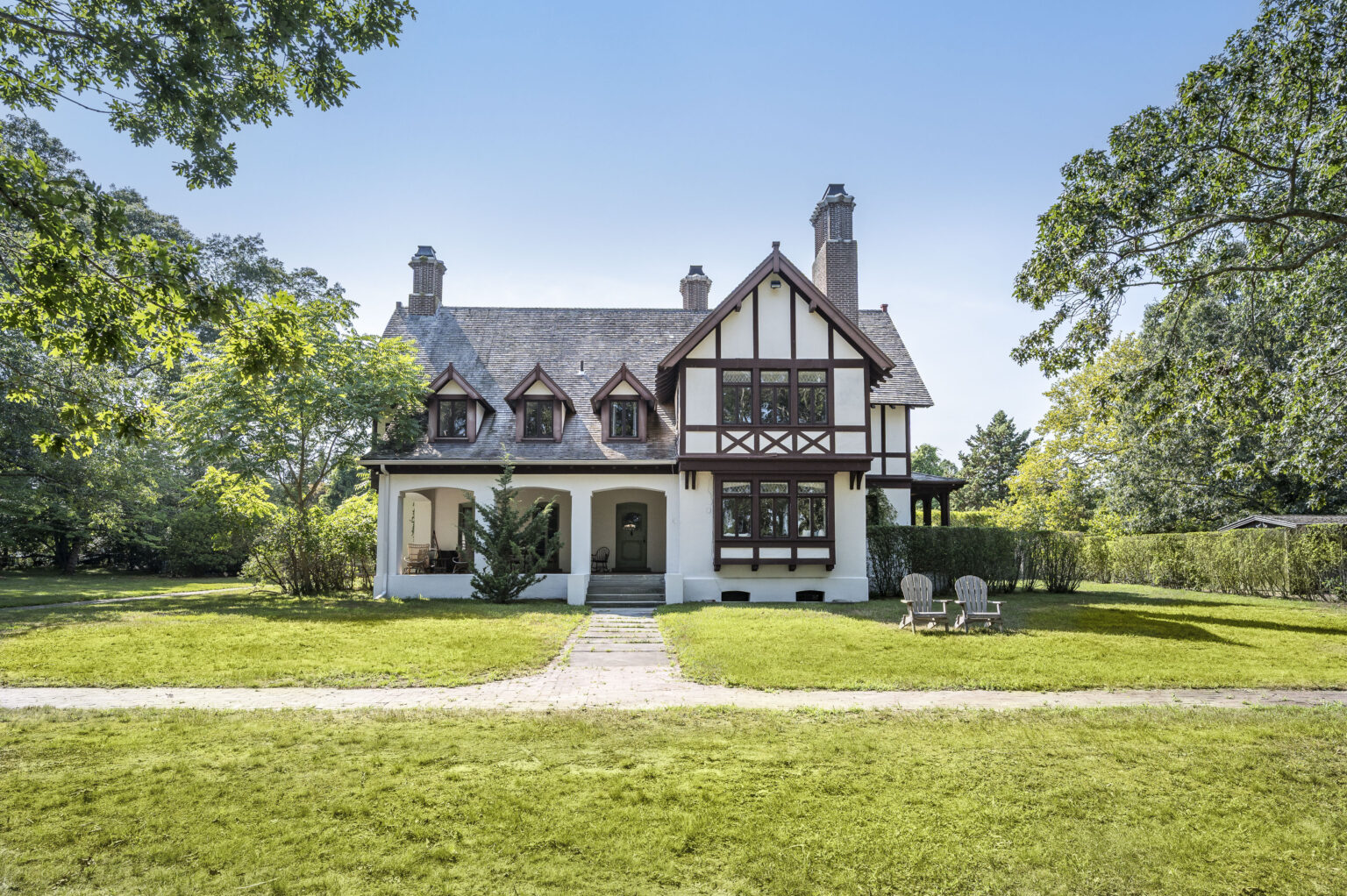
When Louis C.K. quietly listed his storied Shelter Island estate earlier this year, few expected the property—known locally as Primrose Cottage—to linger on the market. Instead, the Louis C.K. Shelter Island home sold swiftly for $4.35 million, closing approximately $50,000 above the asking price and underscoring continued demand for legacy waterfront estates in New York’s East End.

For readers of californialuxuryhouses, the transaction represents more than a celebrity sale. It is the passing of a residence layered with American cultural history—one that predates its most recent owner by more than a century.

A 1901 Waterfront Estate With Presidential and Cultural Roots
Built in 1901, Primrose Cottage stands on more than two waterfront acres on Shelter Island, positioned between the North and South Forks of Long Island. The Tudor-style residence spans over 5,000 square feet and includes six bedrooms and five bathrooms, along with six restored fireplaces that anchor many of the home’s formal rooms.
Long before the Louis C.K. Shelter Island home entered modern headlines, the estate reportedly served as a summer retreat associated with President Theodore Roosevelt and Vice President William McKinley. It later hosted the 1905 U.S. debut of Peter Pan and was known as a seasonal playground for baseball legend Babe Ruth. While archival documentation varies in detail, the property’s cultural lore has become inseparable from its identity.

Carl Gambino of The Gambino Group at Compass told californialuxuryhouses, “Properties like this are not just residences—they’re part of the historical fabric of Shelter Island. That narrative adds depth that cannot be replicated in new construction.”
Louis C.K. purchased the home in 2014 for $2.44 million, according to public records. Over the following decade, he invested significantly in restoration and modernization while preserving its architectural integrity. The recent $4.35 million sale reflects an estimated gain of nearly $1.9 million before expenses—an appreciable return that also speaks to the resilience of the Shelter Island luxury market.

Inside the Louis C.K. Shelter Island Home: Restoration Meets Modern Comfort
Approaching the Louis C.K. Shelter Island home, visitors encounter a long, tree-lined drive that gradually reveals steep rooflines and dark timber accents emblematic of early 20th-century Tudor design. Mature hedges and landscaping shield the residence from the road, reinforcing the privacy that has long defined the estate.
Inside, hardwood floors and detailed millwork establish a sense of continuity with the home’s origins. Exposed ceiling beams frame the formal living room, where diamond-paned windows admit filtered natural light. Built-in benches beneath the windows create intimate reading alcoves, while one of six fireplaces provides a focal point that feels both historic and functional.

“The goal was never to over-modernize,” Marco Maida of Compass explained to californialuxuryhouses. “The homeowner respected the bones of the property. Updates were made for livability—systems, kitchen, climate control—but the character was left intact.”
The chef’s kitchen exemplifies that philosophy. A professional-grade range sits within a brick alcove that nods to the home’s past, paired with marble countertops, stainless-steel refrigeration, and polished brass hardware. A butler’s pantry enhances utility without disrupting the architectural flow.

Upstairs, the primary suite offers a private retreat with wide-plank flooring, a sitting area, and French doors opening onto a terrace overlooking the pool and surrounding greenery. The en-suite bath maintains period-inspired detailing while accommodating contemporary expectations.
Throughout the Louis C.K. Shelter Island home, the interplay between restoration and modernization feels deliberate rather than cosmetic—a quality that increasingly distinguishes successful historic renovations in today’s luxury market.

Outdoor Living and Deep-Water Access on Shelter Island
Beyond the interiors, the Louis C.K. Shelter Island home fully embraces its waterfront setting. The estate includes a heated Gunite pool and hot tub positioned on an expansive brick terrace bordered by hedges for privacy. Striped awnings echo the home’s early 1900s aesthetic while providing shaded areas for outdoor dining and lounging.
A deep-water dock extends into the inlet, allowing for small boats and watercraft—an amenity that remains particularly valuable on Shelter Island, where maritime culture defines much of daily life.

“Water access is one of the strongest value drivers here,” Gambino noted to californialuxuryhouses. “Buyers on Shelter Island are looking for authenticity, but they’re also looking for lifestyle—boating, privacy, proximity to both forks of the Hamptons.”
Shelter Island itself offers a quieter alternative to the more public-facing Hamptons enclaves. Accessible by ferry from Greenport or North Haven, the island provides relative seclusion while remaining within reach of Manhattan via car and train connections through Long Island. Seasonal restaurants, marinas, farm stands, and boutique inns contribute to a distinctly coastal New York rhythm of life.

Market Context and Investment Perspective
The sale of the Louis C.K. Shelter Island home arrives amid steady demand for historic waterfront properties with acreage. While newer builds in the Hamptons often command higher headline prices, Shelter Island’s appeal lies in its restrained elegance and limited inventory.
Over the past decade, buyers have increasingly shown interest in legacy estates that offer architectural authenticity alongside updated infrastructure. In this context, Primrose Cottage’s combination of restored fireplaces, modernized HVAC systems, and a newly installed heated pool positioned it competitively within its segment.

californialuxuryhouses reached out to Louis C.K.’s representatives for comment regarding the sale but did not receive a response prior to publication.
What remains clear is that the transaction closes a significant chapter in the life of a residence that has bridged presidential retreats, theatrical debuts, athletic legends, and contemporary celebrity ownership. The Louis C.K. Shelter Island home now transitions to a new steward, carrying forward more than a century of layered American narrative.

For Shelter Island, the sale reinforces a familiar truth: properties with genuine historical provenance and waterfront access continue to command attention, particularly when thoughtfully preserved. And for observers of the broader luxury market, it offers a reminder that architectural legacy—when paired with discretion and careful restoration—retains enduring value.